What to know
- Costco's membership fee revenue — up 14% to $2.7B in 24 weeks — is near-100%-margin income that subsidizes prices no competitor can match without bleeding money. The 2024 dues hike caused essentially zero churn, suggesting the fee is price-inelastic.
- The 11% gross margin isn't a weakness — it's only viable because carrying just 4,000 SKUs gives Costco unusual leverage over suppliers who can't afford to lose the volume.
- At a premium valuation as of early 2026, the biggest risk isn't the business breaking — it's the market repricing perfection.
Walk into a Walmart and you'll find roughly 100,000 different products. Walk into a Costco and you'll find about 4,000. That's not a limitation. That's the entire strategy.
Costco cracked something most retailers never will. Sell fewer things. Sell them in bigger quantities at barely any markup. Then charge people an annual fee for the privilege of shopping there. It sounds like it shouldn't work. It works absurdly well.
The latest numbers tell a story of a company that's accelerating when most of retail is grinding. Digital sales are surging. Membership renewals are near all-time highs. And the cash pile keeps growing. But the stock isn't cheap — which means the real question isn't whether Costco is a great business. It's whether the price already reflects that.
What just happened
Costco's fiscal second quarter of 2026 confirmed that the membership machine is humming. The company's U.S. And Canada renewal rate sits at 92.1%, meaning more than nine out of ten members re-up every year. Total paid memberships reached 82.1 million.
In the first 24 weeks of fiscal 2026, membership fees alone brought in $2.684 billion — a 14% jump from the same period last year. Net sales hit $134.2 billion, up 9%. Comparable-store sales (how much existing locations grew, excluding new stores) grew 7%.
The digital side is growing even faster. Online comparable sales surged 22% over the same 24-week stretch. Costco is sitting on $18.24 billion in cash and short-term investments, spending about $6.5 billion on new warehouses this year, and still buying back stock.
First domino: The fee is price-inelastic — and that changes everything
Membership fees brought in $2.684 billion in just 24 weeks, up 14% year-over-year. The cost of collecting those fees is essentially zero — there's no product to source, no warehouse to stock, no shipping to arrange. That money drops almost straight to the bottom line.
The renewal rate of 92.1% in the U.S. And Canada tells you something important: customers don't view this as an expense. They view it as a deal they'd be foolish to give up.
When retention is that high after a price increase, the fee has crossed into rare territory — it's price-inelastic. Most subscription businesses (streaming, SaaS, gym memberships) see measurable churn when they raise prices. Costco didn't. That means the company has a lever it can pull again. And the 14% fee-revenue growth rate suggests the market hasn't fully priced in how much recurring, near-100%-margin income this lever can produce over time.
Costco vs. Traditional Retail: The Membership Fee Advantage
| Metric | Costco | Typical Grocery Chain |
|---|---|---|
| Annual membership fee | $65–$130/year | $0 (loyalty program) |
| Fee margin (% of fee that's profit) | ~100% (near-zero collection cost) | N/A |
| Gross product margin | 11.02% | 25–30% |
| Renewal rate after price hike | 92.1% (price-inelastic) | N/A (no fee) |
Second domino: 4,000 SKUs give Costco monopsony power over suppliers
For the 12 weeks ending February 15, 2026, Costco's gross margin (revenue minus the direct cost of goods, as a percentage) was 11.02%. A typical grocery chain runs margins of 25–30%. Costco deliberately prices products so low that competitors can't follow without losing money.
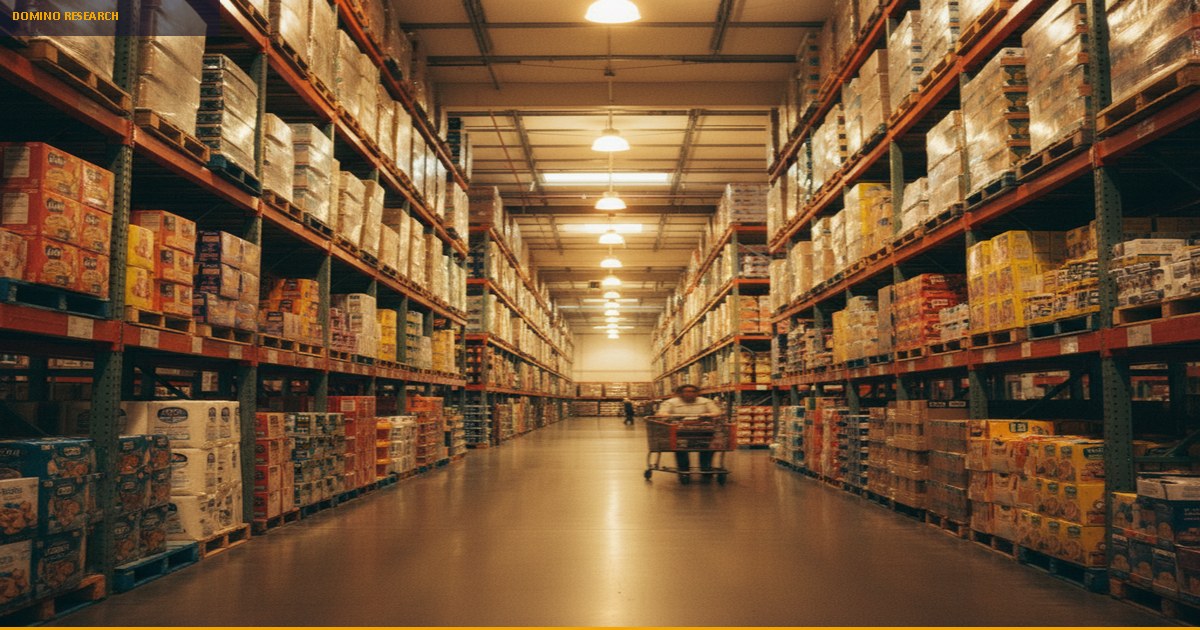
This works because of the SKU (a single product variant a store carries) concentration. Carrying roughly 4,000 products instead of 100,000 means each item sells in massive volume. That volume gives Costco enormous leverage with suppliers — if you're one of only 4,000 products on the shelf, you're moving serious units. That makes every supplier both valuable and replaceable at the same time.
The result is something that functions like a monopsony — a market with effectively one dominant buyer. For a mid-size consumer-brand manufacturer — think P&G, Unilever, or Kraft Heinz — losing a Costco slot isn't just lost revenue. It's lost scale that raises per-unit manufacturing costs across their entire operation. SG&A (selling, general, and administrative) expenses came in at just 9.19% of net sales, which means Costco's operational discipline lets it pass those supplier concessions directly to members rather than pocketing them.
That supplier dependency has a second chapter — and it involves a brand most people don't realize is one of the largest in the world.
Third domino: Kirkland Signature is eating the brands
Private-label products like Kirkland capture margin that would otherwise go to the brand manufacturer. The limited shelf space makes this even more powerful. With only about 4,000 SKUs, Kirkland doesn't face the usual wall of competitors that a store brand does at Walmart or Target. Fewer choices mean less decision fatigue for the shopper. Shoppers reach for Kirkland more often.
Gross margin ticked up 17 basis points (about 0.17 percentage points) in the most recent quarter. That may sound tiny, but on $134 billion in sales, small margin improvements translate into real money. Kirkland's growing trust among shoppers likely contributes to that expansion.
Think about this from P&G's or Kimberly-Clark's point of view. A shelf slot that existed five years ago is now taken by Kirkland. P&G can't buy it back — because Costco doesn't need their marketing dollars. As Costco grows and Kirkland gains trust, the leverage shifts further toward the retailer.
Fourth domino: Zero marketing spend, infinite earned media
Costco drew viral attention by selling one-ounce gold bars through its warehouses and online, with rapid sellouts and waitlists. Gold bars won't move the revenue needle on a $134 billion business, but they generate earned media worth hundreds of millions in brand impressions — for free.
That matters because Costco's marketing spend is structurally near-zero. The company doesn't run national TV campaigns. It doesn't buy Super Bowl ads. Instead, bizarre viral products — gold bars, designer handbags, vacation packages — do the work. Selling gas at near-cost drives foot traffic to the warehouse, where members inevitably spend more.
These surprise products create a "treasure hunt" dynamic that functions as a customer acquisition engine with essentially no cost. That stickiness shows in the numbers: 82.1 million paid members and a 92.1% renewal rate. Compare that to a company like Walmart, which spends billions annually on advertising to drive the same foot traffic Costco gets organically.
The treasure hunt also extends to a place most people don't associate with Costco: the internet.
Costco once sold a $400,000 diamond ring right next to a pallet of toilet paper. That's not random — it's a calculated move. It turns shopping into a treasure hunt and creates the kind of buzz no ad budget can buy.
Fifth domino: The digital surge nobody expected
Digitally-enabled comparable sales grew 22% over the 24-week stretch ending February 2026. That's not a small e-commerce experiment. That's a meaningful growth engine running alongside the physical stores.
Costco's limited product selection — the same 4,000-SKU strategy that works in warehouses — may actually be an advantage online. Fewer choices reduce the overwhelming scroll that plagues most e-commerce sites. When you search "paper towels" on Costco's site, you get a handful of options instead of 200. That simplicity can improve conversion rates.
Total comparable sales grew 7% company-wide. The digital channel is growing at more than three times that rate. If Costco keeps growing digital sales by 20%-plus while its stores keep humming, it becomes a brutal competitor. It wins in stores. It wins online. And it funds both with a subscription fee.
But all of this good news comes with a price tag — literally.
The last time this happened
Costco's model has a closer cousin than most people realize — not Amazon, but Sysco. In the 1990s and 2000s, Sysco came to dominate food distribution to restaurants and hospitals. How? Nothing flashy — just tight logistics, trimming product variety, and locking in buyers who couldn't leave. Restaurants and hospitals couldn't easily switch. Sysco's scale meant lower per-unit costs that smaller distributors just couldn't match. The moat wasn't sexy. It was structural.
Costco is running a similar playbook in consumer retail. The 92.1% renewal rate is comparable to the best software-as-a-service companies. Losing a Costco slot raises a manufacturer's per-unit costs. That mirrors what happened with Sysco's restaurant clients. Their switching costs weren't buried in Sysco's contracts — they were baked into their own economics.
The company generated $7.684 billion in operating cash flow in just 24 weeks. It's using that cash to open new locations at a pace of roughly $6.5 billion in capital spending this year. But Sysco's history also carries a warning: when the company pushed into new geographies too aggressively in the mid-2000s, margins compressed and the stock went sideways for years. The question for Costco is whether its expansion pace can hold without diluting the operational discipline that makes the model work.
What could go wrong
Valuation compression is the biggest risk. As of early 2026, Costco's trailing P/E (the stock price divided by the last 12 months of actual earnings) sits around 52x. That's roughly double the S&P 500 average. The premium is justified only if the membership flywheel keeps compounding at its current rate. If comparable sales growth slows from 7% to 3–4% — as it did in 2015–2016 — the multiple can compress fast. During that earlier slowdown, Costco's stock went sideways for over a year as the market repriced the growth trajectory. A repeat would mean the business keeps performing well while shareholders go nowhere.
SG&A creep could erode the model. Operating costs as a share of sales ticked up 13 basis points in the latest quarter. If SG&A as a percent of net sales crosses 9.5% for two consecutive quarters, the cost-discipline moat that justifies the premium multiple is structurally impaired. Wage inflation, new warehouse openings, and e-commerce fulfillment all push costs higher. That's a specific number to watch.
Amazon Fresh and Sam's Club are closing the gap. Amazon's grocery ambitions have stumbled, but the company has the resources to iterate indefinitely. Sam's Club, Walmart's warehouse division, is investing heavily in digital and in-store experience. In urban markets, Costco has fewer warehouses. If either competitor closes the gap on price and experience there, the renewal rate — the single most important metric in the model — could slip.
Watchlist
| Ticker | Level | Status | Why |
|---|---|---|---|
| COST | $925 (as of April 2026) | holding | The core story. Membership flywheel is accelerating, digital is surging, but valuation is stretched at roughly 52x trailing earnings as of early 2026. |
| WMT | — | watching | The direct competitor. Walmart's Sam's Club runs a similar membership model — watch for whether it closes the renewal-rate gap. |
| PG | — | watching | Kirkland Signature's growth directly pressures CPG brands like P&G. If Costco's private label keeps gaining share, brand margins shrink. |
| BJ | — | watching | BJ's Wholesale is the smaller warehouse club. If Costco's model is working this well, BJ's may benefit from the same tailwinds — at a lower valuation. |
Get the weekly digest
One email every Saturday. New stories, new research, no upsell. Unsubscribe with one click.