What to know
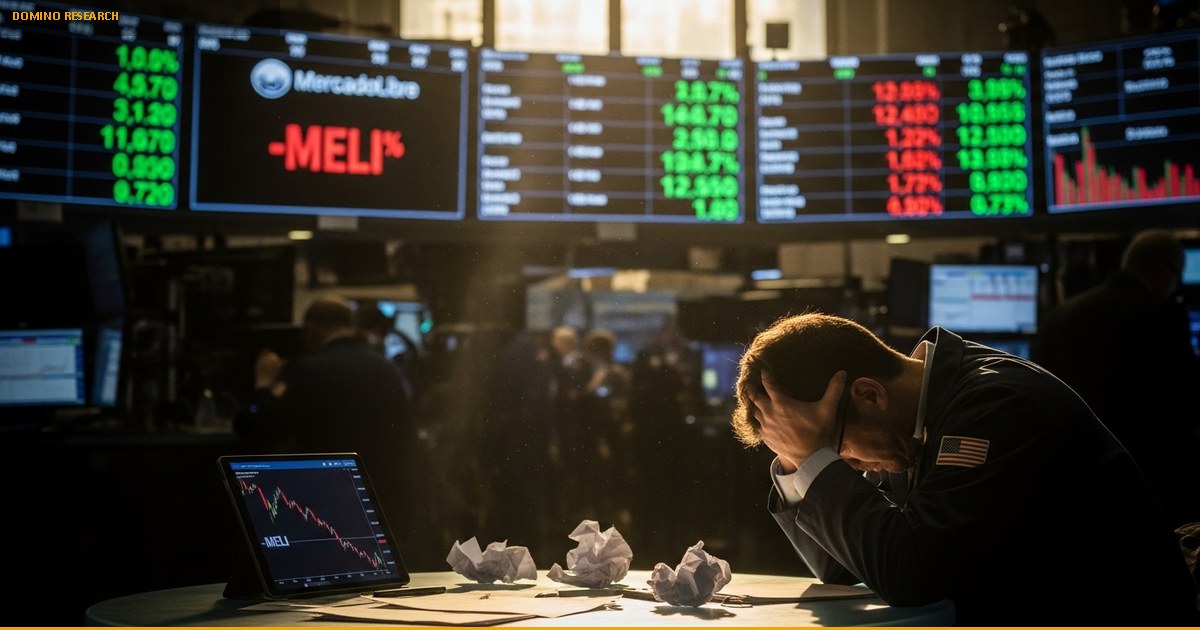
- MercadoLibre dropped 4.6% on triple normal volume despite reporting 49% revenue growth.
- The real problem: the company nearly quadrupled its workforce since 2021, squeezing operating margins to 6.9%.
- If margins don't inflect by Q3 2026, MELI's premium valuation becomes indefensible — and the selloff has only just started.
Imagine your favorite restaurant doubled its customers overnight. Lines out the door. Revenue through the roof. But when you looked at the books, profits barely budged — because the owner hired four times as many staff and opened new locations as fast as possible.
That's MercadoLibre right now. The company most people call "the Amazon of Latin America" just posted one of the strongest revenue quarters in its history. And the stock got hammered.
This isn't a story about a company falling apart. It's a story about investors losing patience with growth that hasn't turned into profit yet. And the chain reaction it's triggering tells you something important about how markets price ambition versus results.
A company growing revenue 49% shouldn't be trading near its 52-week low. Unless investors have stopped believing growth will ever turn into profit.
What just happened
MercadoLibre — the company that powers online shopping, digital payments, and logistics across Latin America — fell 4.61% in a single session on May 11. That alone wouldn't be remarkable. What made it notable was the volume: nearly 1.86 million shares changed hands, more than 3.3 times the stock's normal daily volume.
The stock closed at $1,557.30. That's roughly $36 above its 52-week low of $1,593.21 — and a staggering 41% below its 52-week high of $2,645.22.
The strange part: this selloff happened after MELI reported Q1 2026 revenue of $8.85 billion, up 48.9% from the same quarter last year. In most universes, a company growing revenue nearly 50% would be rewarded. In this one, it got punished.
First domino: The margin squeeze nobody can ignore
MELI posted $8.85 billion in revenue in Q1 2026 but only $611 million in operating income — an operating margin of just 6.9%. Net income was $417 million.
As of May 11, 2026, the stock's trailing P/E (the price divided by the last twelve months of actual earnings) sat at 41.12. That's a premium price tag that only makes sense if margins are expanding, not shrinking.
Investors are doing simple math: if you're paying this premium valuation for a company whose margins are this thin, you need to believe profits will catch up to revenue fast. The Q1 numbers didn't provide that reassurance. The stock has now fallen about 14% in just one week and about 13% over the past month.
Second domino: The hiring spree that's eating the profits
MELI went from 29,957 employees in 2021 to 123,670 in Q1 2026 — a fourfold increase in under five years. In 2025 alone, the company added more than 39,000 new team members. That's roughly the population of a small city.
This hiring spree is the engine behind MELI's expansion into logistics, fintech, and new markets — and the primary reason margins are so thin. Capital expenditures amplified the pressure, hitting $271 million in Q1 alone.
The company is making a bet: spend aggressively now to lock in market share across Latin America, and harvest the profits later. Brazil contributed $4.77 billion in Q1 revenue, Mexico added $1.98 billion, and Argentina contributed $1.70 billion. Those are enormous markets worth fighting for. But investors are signaling that the "spend now, profit later" story needs a clearer timeline.
Third domino: The AI productivity bet that hasn't shown up in the numbers yet
According to MercadoLibre's Q1 2026 earnings presentation, about 95% of MELI's employees have adopted GenAI tools in their daily work. Over 23,000 employees were specifically trained on AI tools. And roughly 30% of the code that reaches production is now written with AI assistance.
The company also built a proprietary AI bot that handles over 1.4 million customer inquiries per year. Merged code contributions — a measure of developer productivity — jumped about 40% (per the same Q1 2026 earnings materials).
But these efficiency gains haven't translated into margin improvement yet. AI-driven productivity tends to show up in the numbers with a delay. Companies invest in adoption first, then see cost savings in the quarters that follow. If MELI's AI bet pays off, a 123,000-person workforce using AI tools could eventually produce the output of a much larger team — without the matching cost increase.
95% of MELI's workforce has adopted AI tools. 30% of production code is AI-assisted. But none of it has shown up in the margins yet.
Fourth domino: The fundraising chill hitting LatAm startups
When venture capitalists and growth-equity funds price a LatAm fintech or e-commerce startup, MELI's public-market multiple is one of the first comps they reach for. A startup pitching "we're building the Shopify of Brazil" gets valued, in part, by reference to how the market values MELI's revenue. When MELI's valuation multiple shrinks, the ceiling on every similar private company's valuation drops with it.
Brazil and Mexico alone represent $6.75 billion of MELI's $8.85 billion revenue — a concentration that means any LatAm slowdown hits MELI disproportionately hard. And when the region's biggest public company trades below its own growth rate, local venture capital funds that benchmark against it face pressure to mark down the value of companies they already own.
The result is a fundraising chill that extends well beyond MELI's own stock price. Smaller LatAm fintechs that need fresh capital in H2 2026 may find that MELI's margin problem has quietly raised their cost of capital — even if their own unit economics — how much money you make or lose on a single sale are healthy.
Fifth domino: The $5.65 billion war chest — and the management bet behind it
MELI carries $3.68 billion in cash and $1.97 billion in short-term investments — a combined $5.65 billion war chest. That's enough runway to maintain aggressive growth spending even if the stock falls further. But it also removes the urgency to cut costs and improve margins, which is exactly what impatient investors want to see.
Then there's the management incentive layer. MELI's CEO has a 2026 long-term incentive award worth up to $14 million. The payout depends on how the stock price performs compared to its average closing price over the last 60 trading days of 2025.
In other words, management's payday depends on the stock recovering. That doesn't guarantee anything. But it does mean the people running the company have a personal financial reason to focus on exactly what investors are punishing them for: margins and profitability. The question is whether the $5.65 billion cushion lets them take too long to get there.
The last time this happened
The closest structural parallel isn't Amazon — it's Sea Limited in 2021–2022. Sea is the Singapore-based parent of Shopee and SeaMoney. It was the top digital platform in Southeast Asia — e-commerce, fintech, and gaming all under one roof. Revenue was growing at triple-digit rates, but the company was burning cash on logistics and expanding into new markets. Sound familiar?
In late 2021, Sea traded above $350 per share at a premium multiple. By mid-2022, it had fallen below $60 — an 80%-plus drawdown — as investors lost patience with thin margins and an unclear path to profitability. The selloff wasn't driven by collapsing revenue; Sea's top line kept growing. The market simply decided that growth without margin proof wasn't worth the price of admission.
Sea eventually recovered by slashing costs and proving unit economics could work. Investors who sold during the "when will growth turn into profit?" phase missed a stock that more than tripled off its lows. MELI's situation looks very similar: a dominant regional platform spending heavily on logistics and fintech, with thin margins that frustrate short-term investors. The key difference is MELI's AI productivity bet — a lever Sea didn't have. Whether that lever pulls fast enough is the question the next two quarters will answer.
What could go wrong
The margin story never inflects. If MELI's operating margin stays below 8% through Q3 2026, the "invest now, profit later" narrative loses credibility. At its May 2026 trailing P/E of roughly 41x, the stock is priced for a margin expansion that hasn't materialized. Two more quarters of sub-8% margins would force analysts to reprice the stock on current earnings, not future hopes.
Competition takes a measurable bite. Shopee (owned by Sea Group) has been expanding aggressively in Brazil, MELI's largest market. Watch Sea Group's next earnings report. If Shopee's Brazil sales volume speeds up sharply in the second half of 2026, that's a bad sign for MELI. It would mean all their heavy spending on logistics and hiring isn't winning lasting market share — it's just keeping up. That would undermine the core justification for thin margins.
The 52-week low breaks. The 52-week low of $1,593.21 is now the critical support level. If it breaks on heavy volume, it could trigger a wave of selling from funds that trade on charts and momentum. That would push the stock down much further than the business results alone would justify.
Watchlist
| Ticker | Level | Status | Why |
|---|---|---|---|
| MELI | $1,557.30 | monitoring | Trading roughly $36 above its 52-week low of $1,593.21 after a 14% weekly decline. The next earnings report will either validate the growth-to-profit story or break it. |
| Confirms: Close above $1,750 within 30 days on rising volume = selling pressure exhaustedBreaks: Close below $1,593.21 (52-week low) for 3+ consecutive days = new downtrend confirmed | |||
| MELI | N/A — earnings date | catalyst | MELI's Q2 2026 earnings (expected ~August 2026) are the single most important catalyst. Operating margin vs. the 8% threshold will determine whether the investment narrative holds or collapses. |
| Confirms: Q2 2026 operating margin ≥ 8% = margin inflection underway, investment thesis intactBreaks: Q2 2026 operating margin < 6.5% = spending-to-profit bridge is longer than the market will tolerate | |||
Get the weekly digest
One email every Saturday. New stories, new research, no upsell. Unsubscribe with one click.