What to know
- MELI grew revenue 49% YoY but net margin fell below 5 cents on the dollar — the worst revenue-to-profit conversion ratio since it launched its lending business, signaling the investment phase is getting more expensive, not cheaper.
- Baillie Gifford sold $479 million in MELI shares in a recent portfolio rebalancing — a signal that one of the world's top growth investors shifted conviction on the risk-reward.
- MELI's $10.7 billion loan book with a $3.8 billion bad-loan reserve is the hidden risk most investors aren't watching.
Imagine your favorite restaurant doubles its customers overnight. Lines out the door. Revenue through the roof. But the owner just told you he's giving away free appetizers, hiring triple the staff, and lending money to customers who might not pay him back.
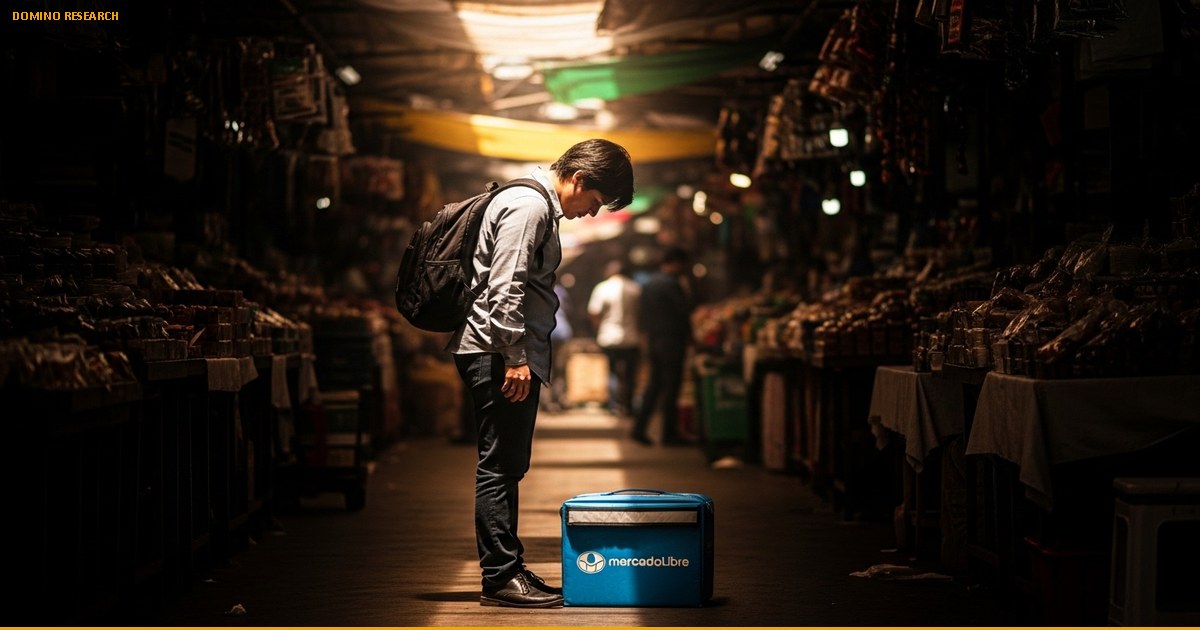
That's basically what just happened to MercadoLibre — the company often called "the Amazon of Latin America." It reported blowout revenue. The stock cratered anyway.
The 12.7% single-day drop is dramatic enough. But the real dominoes are falling behind the scenes. A major growth fund sold out of the stock. The lending business quietly became enormous. And the workforce quadrupled in four years. Let's trace the chain.
Revenue through the roof. Profits shrinking. The market just told MercadoLibre: 'We'll pay for growth, but not like this.'
What just happened
MercadoLibre — the largest e-commerce and fintech platform in Latin America — reported Q1 2026 earnings on May 8, 2026. Revenue came in at $8.85 billion, up 49% from $5.94 billion a year earlier. That's a monster growth number. Wall Street loved it.
But net income told a different story: just $417 million. The company deliberately spent more on free shipping, credit expansion, and logistics to grab market share. In other words, MELI chose growth over profit.
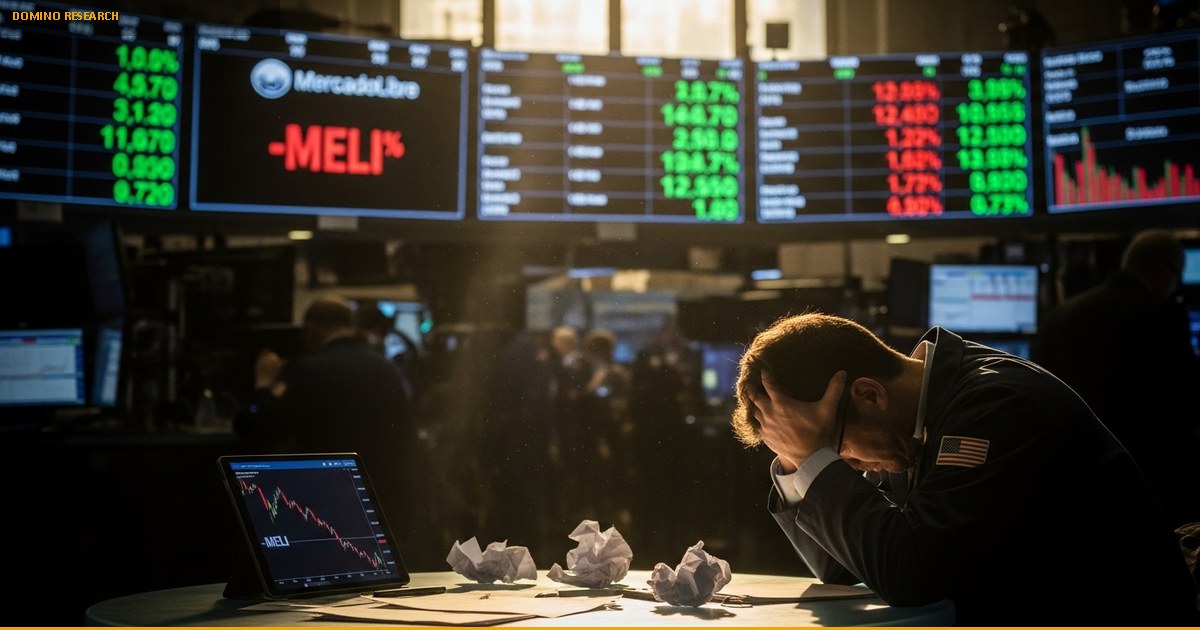
The market's reaction was swift and brutal. MELI dropped 12.7% to $1,632.52 on May 8, with trading volume hitting 2.33 million shares — nearly five times the 20-day average of 482,430. That kind of volume spike means this wasn't retail panic. Big institutional investors were making large moves out of the stock.
First domino: The shareholder rotation trap
MELI trades at a trailing P/E of 43.1. At that price tag, most shareholders are GARP funds — growth-at-a-reasonable-price investors. They'll pay up for a stock, but only as long as earnings growth keeps pace with revenue growth.
When the company showed up with 49% revenue growth but compressed margins, the math broke. Revenue of $8.85 billion paired with only $417 million in net income means MELI is converting less than 5 cents of every revenue dollar into profit.
The stock fell roughly 8% in the month through May 8, 2026, and is hovering just above its 52-week low of $1,593.21. That's not a one-day blip — it's a multi-week de-rating as GARP funds hit their margin thresholds and are structurally forced to sell. The question now is who the next natural buyer is: deep-value funds won't touch a 43x P/E, and momentum funds won't touch a stock in freefall. MELI is stuck in a no-man's-land between buyer bases.
Second domino: Baillie Gifford rebalances out
Baillie Gifford sold 248,000 MercadoLibre shares worth approximately $479 million, according to regulatory filings. That's not a trim. That's a meaningful reallocation of capital away from MELI.
Important context: 13F filings, which disclose institutional holdings, are reported with a 45-day lag. That means this sale may have occurred before the May 8 earnings report — which would suggest Baillie Gifford's conviction shifted on the thesis itself, not just the quarterly numbers. If the sale preceded the earnings miss, it's a stronger signal of fundamental reassessment than a post-miss reaction.
The 4.83x volume ratio on the selloff day suggests follow-on institutional repositioning may already be underway. The next wave of 13F filings (due in mid-August 2026) will reveal whether other large growth funds followed Baillie Gifford's lead.
When a fund with Baillie Gifford's reputation rebalances out of a position this size, it creates a two-part problem: mechanical selling pressure and follow-on repositioning from every fund watching.
Third domino: The hidden bank inside MercadoLibre
As of March 31, 2026, MELI's total loans receivable stood at $10.7 billion. To put that in perspective, that's larger than the loan book of many mid-size U.S. Banks. This isn't a side business — it's a core pillar of the company.
The concerning part: MELI has set aside $3.82 billion in allowance for doubtful accounts — a reserve for loans the company expects borrowers won't repay. If Brazil's economy stumbles, these provisions could prove insufficient.
Lending in emerging markets like Brazil (which generated $4.77 billion in Q1 2026 revenue alone) carries higher default risk than developed markets. If Latin America's economy gets worse, those loan losses could pile up fast. MELI's growth engine would start dragging down earnings instead.
Fourth domino: A workforce that quadrupled — and the fixed-cost cliff
MELI quadrupled headcount from 29,957 (end of 2021) to 123,670 (end of 2025), adding more than 39,000 employees in 2025 alone.
That's an enormous fixed-cost base. When revenue is growing 49% a year, you can absorb it. But if growth slows even modestly — say, to 25–30% — those salaries, benefits, and office costs don't shrink with it. The margin compression the market just punished could get worse before it gets better.
Here's where it gets interesting: about 95% of MELI's employees have adopted AI tools, and roughly 30% of the company's production code is now written with AI assistance. If AI keeps headcount roughly flat through 2026 while revenue grows another 30%+, profits should improve a lot by Q4. Each dollar of revenue would carry less labor cost. That's the bull case for patience. But the market is pricing the cost structure it can see today, not the efficiency gains it hopes for tomorrow.
Fifth domino: Management's six-year bet on themselves
CEO Ariel Szarfsztejn's target award is $14 million; CFO Martin de los Santos's is $4 million.
The performance metrics tied to these payouts include net revenues, operating income, total payment volume, and competitive Net Promoter Score. Notice what's not on that list: short-term earnings per share. Management is compensated for building scale and customer loyalty, not for hitting quarterly profit targets.
This is either a sign that the investment phase will eventually yield strong returns — or a convenient structure for years of margin compression. The market, right now, is betting on the latter.
Historical parallel: When growth lenders hit a credit cycle
The easy comparison is Amazon around 2014. Bezos chose growth over profits for years, and Wall Street threw fits along the way. But patient investors were rewarded with a 10x return over the next five years.
But the tighter parallel is MELI's own recent history and the broader Latin American fintech credit cycle. In 2022–2023, Nubank — another giant Latin American fintech — saw its loan-loss costs surge as borrowers across Brazil struggled to pay back debt. Nubank's stock lost more than half its value from its IPO price before recovering once provisions stabilized. MELI's Mercado Credito business faced a similar NPL (non-performing loan) spike in 2023, which forced the company to tighten underwriting standards.
But here's the key difference: Amazon was building warehouses in the world's largest consumer economy, backed by a stable currency. MELI is lending billions to consumers across economies where currencies swing wildly, rules change fast, and inflation can spike without warning. The Amazon playbook can work in Latin America, but the structural risks — especially on the lending side — are materially higher.
The lesson from Nubank's recovery: if MELI can stabilize its loan-loss reserve as a percentage of total loans over the next two quarters, the stock has a template for recovery. If the reserve ratio climbs above 40%, the 2023 credit-cycle playbook says the pain isn't over.
What could go wrong — with our thesis
Risk 1: The margin compression is temporary, and we're overweighting one quarter. MELI deliberately chose to invest in growth this quarter. Here's the bull case checkpoint: if Q2 2026 net income tops $550 million (meaning net margins recover to roughly 6%) and operating expenses grow less than 35% year over year, the "we're investing for the future" story holds up. The selloff was just noise. For context, year-ago Q1 2025 net income was $494 million, so the Q1 2026 figure of $417 million partly reflects strategic spending choices, not structural deterioration.
Risk 2: The loan book holds up better than feared. MELI's 36% reserve ratio looks alarming in isolation, but if Q2 shows the reserve ratio stable or declining while the loan book grows, it means credit quality is improving even as lending scales. The specific trigger: if the allowance-for-doubtful-accounts ratio falls below 33% of total loans in Q2, the hidden-bank risk is fading.
Risk 3: The bull case is stronger than we're giving it credit for. As of Q1 2026, MELI has $3.68 billion in cash and $15.1 billion in total liquidity. Revenue is still growing 49% YoY. Fintech revenues are growing even faster. Management is pushing AI hard — 95% of employees use it, and it writes 30% of production code. That could squeeze more profit from each dollar of revenue, making today's high costs look temporary. The next 13F filing window (mid-August 2026) will show whether institutional selling broadened beyond Baillie Gifford or whether the fund was an outlier. If other large growth funds held or added, the copycat-selling thesis is dead.
Watchlist
| Ticker | Level | Status | Why |
|---|---|---|---|
| MELI | $1,593 (52-week low, set in May 2026) | approaching | 52-week low is the technical support line. A break below it on heavy volume signals the market has fully lost confidence in the growth-over-profit strategy. |
| Confirms: Closes above $1,750 within 30 days = selling pressure absorbed, thesis shifts to 'investment phase, not crisis'Breaks: Closes below $1,593 for 3+ consecutive days = technical breakdown, broader institutional repositioning likely | |||
| MELI | Q2 2026 net income vs. $417M (Q1 2026) and $494M (Q1 2025) | monitoring | Q2 net income is the key fundamental test. Watch both sequentially and year-over-year — Q1 was compressed by strategic investments, so seasonal and YoY context matters. |
| Confirms: Q2 2026 net income above $550M with OpEx growth below 35% YoY = margin trajectory improving, selloff was overreactionBreaks: Q2 2026 net income below $350M = margin compression accelerating regardless of strategy | |||
Get the weekly digest
One email every Saturday. New stories, new research, no upsell. Unsubscribe with one click.