What to know
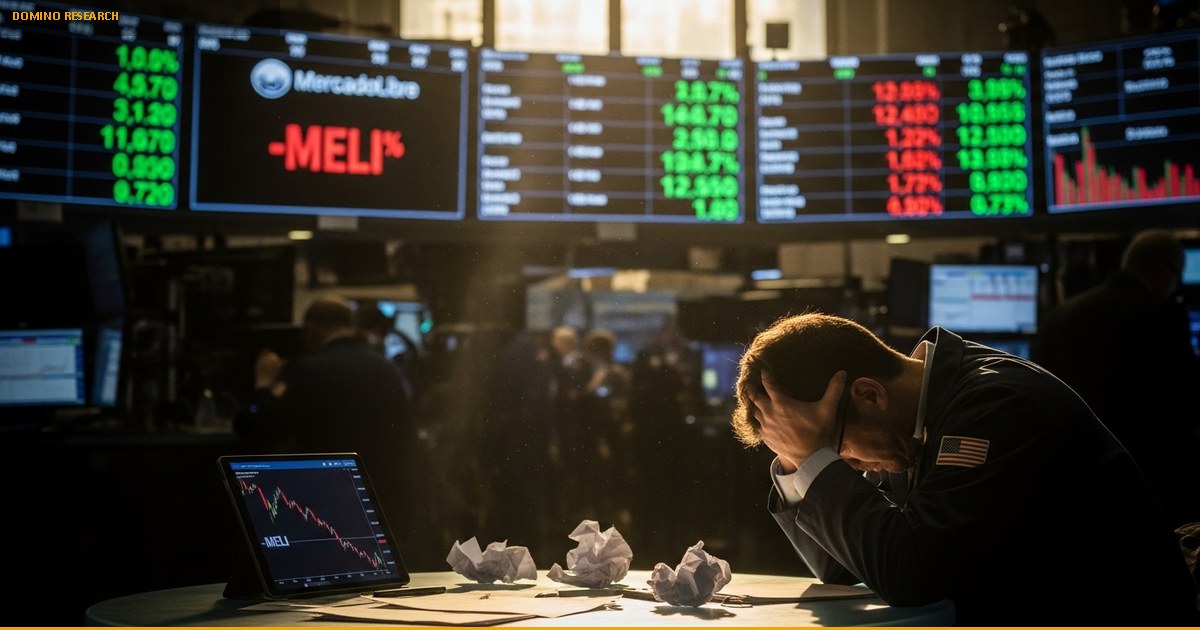
- MercadoLibre crashed roughly 11% the day after Q1 2026 earnings as profits shrank despite revenue surging 49% to $8.85 billion.
- A single $940M institutional exit by hedge fund WCM triggered algorithmic pile-on selling that amplified the damage far beyond what the earnings miss alone warranted — a structural quirk of high-beta growth stocks.
- The stock is near its 52-week low — what happens next depends on whether this is Amazon 2014 or WeWork 2019.
Imagine your favorite restaurant doubled its seating, hired twice the staff, and started offering free delivery. Then it reported lower profits because of all that spending. Would you panic? Or would you think, "They're playing the long game"?
That's exactly the fight happening right now over MercadoLibre, the company that runs Latin America's version of Amazon and PayPal rolled into one. On May 7, 2026, MELI reported blowout revenue growth. The stock cratered the following day.
The reason why tells you something important about how Wall Street prices growth companies — and why the next few quarters could be a defining moment for the biggest tech stock south of the border.
What just happened
MercadoLibre reported Q1 2026 earnings on May 7, 2026, and the numbers told two very different stories.
The top line was spectacular. Revenue surged 49% year-over-year to $8.85 billion. Buyer growth and platform activity hit record levels across Brazil, Mexico, and Argentina. By any growth metric, the quarter was a home run.
But the bottom line went the wrong direction. According to MercadoLibre's Q1 2026 earnings release, net income fell to $417 million from $494 million in Q1 2025, and diluted EPS dropped to $8.23 from $9.74. The company deliberately chose to spend aggressively on free shipping, credit expansion, and logistics.
Wall Street's verdict came the next day. The stock fell roughly 11% on May 8 on massive volume. That's the kind of selling that doesn't come from retail investors panicking on their phones. That's institutional money heading for the exits.
Revenue surged 49%. Profits shrank 16%. The stock crashed 12.7%. Wall Street wanted both halves of the story — and only got one.
First domino: A $940 million conviction holder reverses course
Hedge fund WCM sold approximately $940 million worth of MercadoLibre stock, according to regulatory filings. That's not a trim — that's a liquidation. The exact timing and filing type (13F or Form 4) should be confirmed when the next quarterly disclosure is published, but the scale of the exit is not in dispute.
The mechanics matter less than the signal. WCM's reversal shows that smart money is rethinking whether Mercado Pago's lending business will actually pay off. WCM was a long-term conviction holder — the kind of fund that builds a position over years because it believes in the fintech flywheel. When that type of investor exits entirely, it suggests the thesis itself has changed, not just the quarter's numbers.
The volume tells the story. MELI traded at nearly five times its 20-day average volume on the sell-off day. With a beta (how much the stock moves when the broader market moves 1%) of 1.41 — meaning MELI typically swings about 40% more than the broader market — this kind of institutional exit creates outsized price damage. Amazon and Sea Limited (Shopee) are both spending big now to profit later in Latin America. But neither stock saw a similar single-fund sell-off. That tells us the WCM exit was about MELI specifically — not a broad shift away from the sector.
Second domino: The valuation repricing exposes MELI's shareholder fragility
Before the May 7 earnings report, MELI had been trading at a trailing P/E (how many years of past earnings the stock costs) of about 41x. That's an expensive ticket. Investors were paying that price because they believed MELI could grow revenue fast AND keep profits rising.
Q1 broke that assumption. Revenue grew 49%, but net income shrank 16%. Management made a clear choice: grab market share and build the ecosystem now, even if it means lower profits in the short term. They poured money into free shipping, credit expansion, and logistics.
What makes MELI's repricing particularly violent is its shareholder composition. MELI is not included in most major emerging-market indexes, which means passive EM funds don't provide a natural floor of buying support. The shareholder base skews toward active growth funds with strict drawdown (the peak-to-trough decline in the stock's price) limits. When the first big holder exits, there's no index-tracking bid to absorb the supply. The stock was sitting near its 52-week low of $1,593.21 as of early May 2026, with very little cushion before entering truly uncharted territory.
Third domino: The credit expansion gamble in emerging markets
MELI didn't just increase shipping subsidies. It ramped up credit expansion through Mercado Pago, its fintech arm. Revenue from financial services helped push total revenue to $8.85 billion, but margins compressed in the process.
The company's operating margin (profit from operations as a percentage of revenue) dropped to roughly 7% — $611 million on $8.85 billion in revenue. For context, gross profit was $3.86 billion, meaning the company is spending enormous sums between the gross profit line and the operating income line.
Rapid credit expansion in emerging markets during a period of declining profits is a combination that makes risk managers nervous. If loan losses spike in Brazil, Mexico, or Argentina, the profit picture gets worse before it gets better. According to MercadoLibre's Q1 2026 earnings release, Brazil alone generated $4.77 billion in revenue, making it the single biggest concentration risk.
Fourth domino: AI as the hidden efficiency lever
Between approximately 2022 and early 2026, MELI grew from about 30,000 employees to nearly 124,000 — but 95% of those employees adopted generative AI tools in their daily work. According to MercadoLibre's Q1 2026 earnings presentation, about 30% of code reaching production was written with AI assistance as of Q1 2026.
The company also reported a 40% increase in merged code contributions, while IT staff grew only 11% year-over-year. In other words, each engineer is producing significantly more output.
This matters because the central bear case is that MELI is spending too much. If AI tools let the company scale output without proportional headcount growth, the investment cycle could be shorter than skeptics expect. Engineers are already getting more done with less. The question is whether those gains hit the income statement fast enough to keep Wall Street happy.
95% of MELI's 124,000 employees use AI tools. 30% of production code is AI-written. The efficiency gains are real — the question is whether they show up in earnings fast enough.
Fifth domino: The CEO's paycheck is tied to the stock price
CEO Ariel Szarfsztejn took over on January 1, 2026, when founder Marcos Galperin moved to Executive Chairman. His target long-term incentive award for 2026 is $14 million. The CFO's is $4 million, and Executive Chairman Galperin's is $3.5 million. The payout was calculated using the stock price divided by the average closing price during the final 60 trading days of 2025 — a comparison window that has already closed.
With MELI now trading well below those late-2025 levels, the C-suite's compensation is taking a direct hit. Management has a very personal financial incentive to get the stock moving in the right direction.
That doesn't guarantee a shift toward profitability. But it does mean management will feel real pain if the investment-heavy strategy doesn't start producing results. When executives have skin in the game at this scale, they tend to be more responsive to shareholder concerns about margins.
The Amazon 2014 playbook — and why it's not a perfect map
The comparison everyone reaches for is Amazon in 2014. That year, Amazon reported surging revenue and shrinking profits as it invested aggressively in AWS, Prime, and logistics. The stock fell about 25% from its 2014 highs. The reason: the company was spending heavily on data centers and fulfillment.
But the comparison to Amazon is an analytical framework, not a guarantee of identical outcomes. Here's the detail most people miss: what actually ended Amazon's slide. In April 2015, Amazon broke out AWS profits for the first time. The cloud unit was earning 20%+ operating margins — and no one outside the company had known. That single disclosure gave investors a concrete proof point that the spending was producing a high-margin asset. The stock never looked back.
The question for MELI is: what's the equivalent disclosure? What proof point would convince the market that shipping subsidies and credit expansion are building a durable, high-margin business rather than buying temporary market share? The most likely trigger? A quarter where Mercado Pago's loan losses level off while fintech revenue keeps growing. That would prove the lending business can scale without falling apart. Until that moment arrives, the Amazon comparison remains aspirational, not confirmed.
Amazon was investing in cloud computing — a business with 30%+ operating margins that didn't exist yet. MELI is pouring money into shipping subsidies and lending in emerging markets. These are businesses that naturally earn thinner profits and get hit harder when economies slow down. The parallel is instructive but not predictive.
What could go wrong
The credit book cracks. MELI is expanding lending aggressively in Brazil, Mexico, and Argentina — three economies with histories of sudden currency crises and credit contractions. If loan loss provisions spike in Q2 or Q3 2026, the profit picture deteriorates further and the stock's remaining premium evaporates.
The 52-week low doesn't hold. If MELI closes below $1,593 on volume exceeding 3 million shares within the next 30 trading days, the next technical reference point is the 2022 low of approximately $790 — a scenario that would represent a full re-rating to pre-fintech-scaling multiples. The next earnings report will determine whether the market reprices again or holds support here.
The investment cycle extends beyond consensus models. If operating margin remains below 8% for two consecutive quarters through the end of 2026, the profit recovery timeline extends beyond what current analyst estimates assume. Management has said market share comes first. There's no guarantee they change course even if the stock keeps dropping.
Competition heats up. Amazon and Sea Limited (Shopee) are both spending now to profit later in Latin America, with comparable margin pressure. If either rival ramps up spending in Brazil or Mexico, MELI may have to match them. That would stretch out the investment cycle no matter what management wants.
Watchlist
| Ticker | Level | Status | Why |
|---|---|---|---|
| MELI | Near 52-week low (as of May 8, 2026 close) | watching | The stock is near its 52-week low after falling roughly 11% the day after earnings on massive volume. The next earnings report will determine if the investment cycle is working. |
| Confirms: Sustained recovery above $1,850 within 60 days = market accepts the investment narrativeBreaks: Close below $1,593 on 3M+ share volume = new leg down likely, next reference is 2022 low near $790 | |||
| AMZN | N/A | comp watch | Amazon is the historical precedent for 'invest now, profit later.' If AMZN's own margin trends deteriorate, it weakens the bull case for MELI's playbook. |
| Confirms: AMZN maintains or expands operating margins in Q2 2026 = validates invest-through-cycle modelBreaks: AMZN operating margins contract below 10% = growth-at-all-costs model under broader pressure | |||
| EWZ | N/A | macro proxy | Brazil is MELI's biggest market at $4.77 billion in Q1 2026 revenue. Brazil's economy is the single biggest external variable for MELI's credit book. |
| Confirms: EWZ above $30 through Q3 2026 = Brazilian macro stable enough to support credit expansionBreaks: EWZ below $24 = Brazilian recession risk rises sharply, credit losses likely to spike | |||
Get the weekly digest
One email every Saturday. New stories, new research, no upsell. Unsubscribe with one click.