What to know
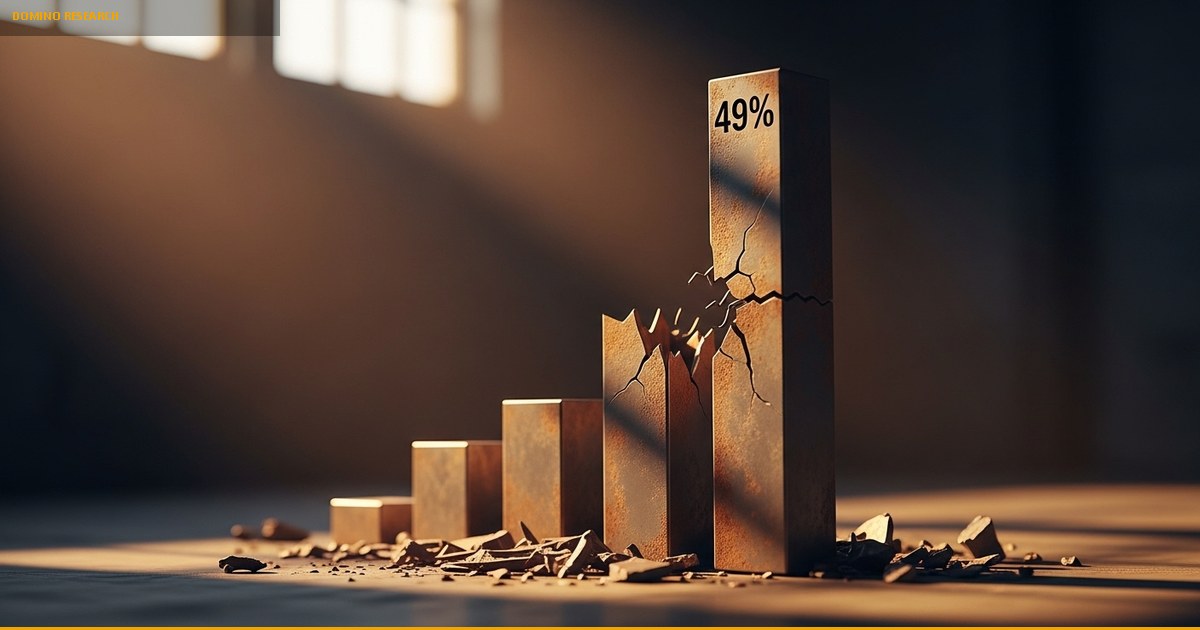
- MercadoLibre dropped roughly 12.7% in one day despite growing revenue 49% because profits shrank.
- Its bad-loan reserves surged — a canary in the coal mine for Latin American consumer credit.
- If the LatAm digital credit cycle is turning, it's not just MELI that needs to reset — every emerging-market fintech valuation is on the clock.
MercadoLibre just posted one of the best revenue quarters in Latin American tech history — and the stock cratered.
On May 7, 2026, the company most Americans have never heard of but that runs the Amazon-plus-PayPal of Latin America reported Q1 earnings. Revenue up 49%. Buyers flooding in across Brazil, Mexico, and Argentina. And the stock dropped roughly 12.7% the next trading session, its worst single-day loss in years.
The punishment didn't come because the business is shrinking — it's growing like crazy. It came because management chose growth over profits, and Wall Street decided it didn't like that trade-off.
But the real story isn't just one stock dropping. It's what that drop tells us about consumer credit in Latin America, the limits of the 'grow at all costs' playbook, and whether this is a buying opportunity or a warning sign.
What just happened
MercadoLibre reported Q1 2026 earnings on May 7th, and the numbers told two completely different stories.
The good story: revenue surged approximately 49% year-over-year to $8.845 billion. The company is adding buyers at record rates across Brazil, Mexico, and Argentina. By any top-line measure, the business is booming.
The bad story: earnings per share fell to $8.23, down from $9.74 a year ago. Net income dropped to $417 million from $494 million. The company grew revenue by half — and made less money doing it.
The market's verdict was swift. MELI fell roughly 12.7% in a single session to around $1,632, on nearly five times its normal trading volume. Hedge fund WCM reportedly sold approximately $940 million worth of MELI shares, according to secondary market reporting. This wasn't a gentle repricing. It was a stampede for the exits.
The company grew revenue by half — and made less money doing it.
First domino: The margin erosion is coming from fintech, not commerce — and that changes everything
Operating margin fell from 12.9% in Q1 2025 to 6.9% in Q1 2026. Gross margin — revenue minus the direct cost of goods, as a percentage also slipped, from 46.7% to 43.7%. The company explicitly chose this path, ramping up spending on free shipping, credit expansion, and logistics infrastructure.
But here's the non-obvious part: the margin erosion is disproportionately concentrated in the fintech segment, not the commerce business. The company is aggressively expanding its lending book — subsidizing credit risk acquisition — rather than just building logistics moats. That distinction matters enormously for how you read this stock.
If MELI were burning margin to build warehouses and delivery routes, you'd evaluate it like an infrastructure investment with a long payoff curve. But burning margin to acquire credit risk in emerging markets is a fundamentally different bet — one where the downside isn't just slower returns, but actual loan losses. The market doesn't pay you for tomorrow's dominance when today's spending is flowing into a credit book that could deteriorate. That's why the stock got hit so hard.
Second domino: The bad-loan problem is growing faster than the business
MercadoLibre's provision for doubtful accounts surged significantly year-over-year in Q1 2026, with some reports citing a roughly $641 million increase. Revenue grew approximately 49% over the same period. The money the company expects to lose on bad loans appears to be growing faster than the business itself.
This is a critical signal. MercadoLibre's fintech arm, Mercado Pago, is the biggest digital lender in Latin America. When the largest lender in a market starts flagging rising defaults, it often reflects broader stress among consumers in that market.
Brazil alone generated $4.774 billion in revenue for MELI in Q1 2026. Mexico added $1.976 billion. If borrowers in those countries are struggling to repay, it's not just a MELI problem — it's a macro problem.
Third domino: The headcount explosion behind the margin squeeze
MELI went from 29,957 employees to 123,670 in four years. In 2025 alone, the company added more than 39,000 new team members. Most of these hires are in logistics — the warehouse workers, drivers, and operations staff needed to build a delivery network that competes with Amazon's.
This hiring spree is a big reason margins compressed. Payroll is one of the largest costs for any company, and when you're adding 39,000 people in a single year, it shows up immediately on the income statement.
There's a counterargument worth noting. As of Q1 2026, management disclosed that about 95% of MELI's employees have adopted AI tools in their work, and roughly 30% of the code that reaches production is now written with AI assistance. If those productivity gains show up, MELI could grow output without hiring at the same rate. That would prove the margin dip is temporary, not permanent.
Fourth domino: The LatAm fintech peer group gets repriced — and some are worse off than MELI
MercadoLibre is the bellwether for Latin American digital commerce and fintech. MELI grew revenue by roughly 49% and still missed what analysts expected. When that happens, fund managers start asking tough questions about every other company in the space.
Take Nubank, the Brazilian digital bank. It has a massive consumer loan portfolio and lends to the same pool of borrowers that MELI is flagging as increasingly risky. Or the wave of buy-now-pay-later competitors across Mexico and Colombia that lack MELI's scale and cash reserves to absorb rising defaults. If MELI — with its $15.1 billion cash pile — can't turn 49% revenue growth into higher profits, smaller competitors face the same cost pressures with far less cushion.
The selling pattern on MELI's earnings day tells a specific story. Nearly 5x normal volume suggests this wasn't retail panic — it was likely a mix of index rebalancing and conviction selling by funds reducing LatAm tech exposure. That distinction matters. Index-driven selling stops on its own once rebalancing is done. But when active fund managers sell out of conviction, it can last for several quarters as they rethink the whole sector's earnings outlook.
Fifth domino: Management's publicly disclosed strategy says 'long game'
CEO Ariel Szarfsztejn's target compensation package is $14 million, structured to pay out over six years with payments tied to stock price performance. This isn't a 'hit your quarterly number and cash out' structure. It's designed to reward long-term value creation.
MELI has also said publicly in its earnings guidance that it's choosing market share and ecosystem strength over short-term profits. Management's disclosed compensation structure and strategic guidance indicate they expect margins to stay compressed for a while — and they've structured their own incentives accordingly.
For investors, this creates a binary setup. If MELI's investments in logistics and lending pay off, the stock's position near its recent lows could look like a gift in hindsight. If they don't, the margin compression could become structural rather than temporary.
Management's publicly disclosed strategy and compensation structure indicate they expect margins to stay compressed for a while.
The Sea Limited playbook: a closer match than Amazon
The most commonly cited parallel for MELI's situation is Amazon — but there's a closer structural match that's more instructive: Sea Limited in Southeast Asia during 2021-2022.
Sea Limited ran a combined e-commerce and fintech platform across Indonesia, Vietnam, Thailand, and the Philippines. That makes it a much closer comparison to MELI's multi-country, multi-product model than Amazon, which dominates a single market. In late 2021, Sea was riding a pandemic-fueled growth wave, aggressively expanding its Shopee e-commerce platform and SeaMoney fintech arm. Wall Street loved the growth story — until it didn't.
Between late 2021 and late 2022, Sea's stock fell roughly 90%. Heavy spending collided with rising interest rates, worsening loan losses in Southeast Asian consumer lending, and investors fleeing unprofitable growth stocks. The parallels to MELI are specific. Both companies combined commerce and lending in emerging markets with shaky currencies. Both saw margins shrink across both business lines at the same time. And both triggered big investors to mark down the entire regional tech sector after their earnings.ings.
The resolution is instructive too. Sea eventually pulled back on international expansion, cut staff, and pivoted hard toward profitability. The stock recovered substantially over the next 18 months. The question for MELI investors is whether the company will be forced into a similar pivot, or whether Latin America's structural growth runway gives it more room to keep investing. Unlike Southeast Asia in 2022, Latin America still has relatively low e-commerce adoption. That gives MELI's "invest now" thesis more room to run. But the credit risk hanging over the business looks strikingly similar.
What could go wrong
Latin American consumers might be heading into a real credit downturn — pushed by high rates, weak currencies, or slowing job growth. If so, MELI's bad-loan reserves, already surging year-over-year, could keep climbing. A fintech lender growing its loan book into deteriorating credit conditions is playing with fire.
Competition could intensify at the worst possible time. Amazon is investing heavily in Brazil and Mexico. Nubank is expanding into commerce-adjacent services. If MELI is spending to defend market share rather than capture it, the return on these investments drops dramatically.
Argentina generated $1.698 billion in Q1 2026 revenue, but the country's chronic inflation and currency instability make that revenue stream inherently fragile. A policy shock or devaluation could erase gains overnight.
The credit thesis has a clear tripwire. If MELI's next two quarterly reports show bad-loan reserves climbing above 14% of revenue, that's a problem. It would mean losses are growing even faster than sales — and the "temporary investment cycle" story falls apart. regardless of revenue growth. At that point, the market would likely reprice MELI as a lender with a deteriorating book, not a tech platform in an investment phase.
Watchlist
| Ticker | Level | Status | Why |
|---|---|---|---|
| MELI | ~$1,632 (as of May 8, 2026) | watching | As of May 8, 2026, MELI closed at approximately $1,632 after a roughly 12.7% drop, near its recent 52-week low around $1,593. The next earnings report will show whether margin compression is stabilizing or accelerating. |
| Confirms: Q2 2026 operating margin above 9% = investment cycle thesis intactBreaks: Close below $1,593 for 3+ consecutive days = institutional capitulation likely; provision/revenue ratio above 14% in Q2 = credit thesis broken | |||
| AMZN | Watch for LatAm segment margin disclosure in Q2 2026 earnings | comparing | Amazon is the historical template for the 'invest now, profit later' playbook and a direct competitor in Brazil and Mexico. Its LatAm segment margins provide a control variable for whether MELI's spending is industry-driven or company-specific. |
| Confirms: Amazon reports LatAm segment margin compression in Q2 2026 = competitive environment forcing everyone to spendBreaks: Amazon reports LatAm margin expansion in Q2 2026 = MELI's spending may be less efficient, not industry-driven | |||
| EWZ | $28 | monitoring | Brazil accounts for over half of MELI's revenue. The iShares Brazil ETF (EWZ) tracks broad Brazilian equity sentiment and currency risk. A sustained move below $28 would signal broad Brazil risk-off that would amplify MELI's credit concerns. |
| Confirms: EWZ holds above $28 through end of Q2 2026 = Brazilian macro stable enough to support MELI's growth storyBreaks: EWZ below $28 for a sustained period = Brazilian macro deterioration threatens MELI's largest market and consumer credit quality | |||
Get the weekly digest
One email every Saturday. New stories, new research, no upsell. Unsubscribe with one click.