What to know
- Grab fell nearly 4% on May 2, 2026, on almost double its normal trading volume, landing just above its 52-week low.
- The company is spending $400 million buying back shares — and the stock is still falling through that support.
- As the stock drops, each buyback dollar retires more shares — meaning a Q1 earnings beat would hit a coiled spring. But if earnings disappoint, there's almost no cushion left.
Imagine you own a lemonade stand. Business is growing. You're so confident in the future that you start buying up your own shares from your partners at a premium. And then, weirdly, everyone else at the table starts selling anyway — faster than you can buy.
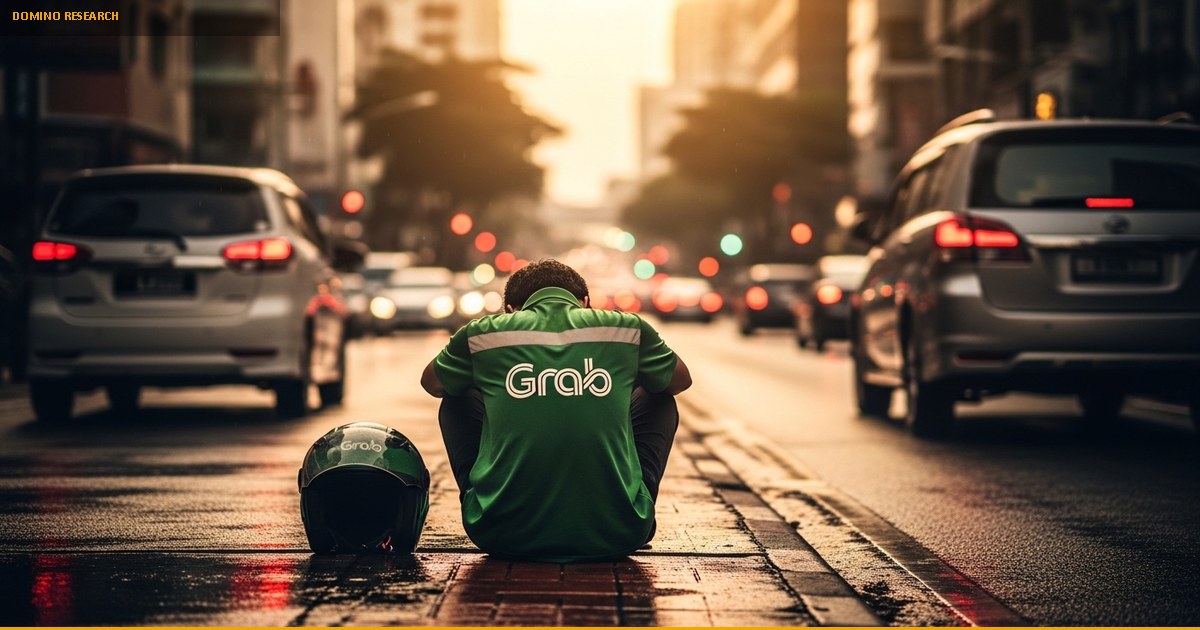
That's basically what just happened to Grab, the Uber-meets-DoorDash of Southeast Asia. The company committed $400 million to buying back its own stock. Wall Street's biggest banks are helping execute the deal. And yet the stock just dropped nearly 4% on a day when almost twice the normal number of shares changed hands.
When a company is actively propping up its own stock and it still falls, it tells you something uncomfortable: the sellers are more motivated than the buyer. Let's trace the dominoes.
What just happened
On May 2, 2026, Grab Holdings dropped 3.93%, closing at $3.67. That alone isn't headline-worthy — stocks move. What made this notable was the volume behind it.
Grab traded 99.7 million shares that day, compared to its 20-day average of about 57.5 million. When a stock drops on light volume, it's often noise. When it drops on nearly double its normal activity, a lot of people decided to sell at the same time.
The stock had already slipped 1.04% the day before. So this wasn't a one-day event — it was an acceleration of selling pressure heading into a critical stretch for the company.
First domino: A stock priced for perfection with a history of disappointing
As of early May 2026, Grab's trailing P/E (how many years of past earnings the stock costs) sat at 61.17. Analysts expected earnings growth to bring that ratio down to about 25 based on future earnings. But that math only works if the growth actually shows up.
Here's the problem: Grab has a weak track record of beating analyst estimates. The market is pricing in a bright future, but the company hasn't consistently delivered on those expectations. When a stock trades at this kind of premium, even a slight miss can trigger outsized selling.
As of May 2, 2026, the stock's 52-week range told the story: it traded as high as $6.62 and sat just 19 cents above its 52-week low of $3.48. There's almost no cushion left before the stock hits a new floor — and earnings are right around the corner.
Second domino: The $400 million buyback that can't stop the bleeding
In late March 2026, Grab announced it would execute up to $400 million of a $500 million buyback program authorized by its board. This wasn't a vague promise. They signed a $250 million buyback deal with JPMorgan Chase and a $150 million share purchase deal with Morgan Stanley.
Those are two of the biggest banks on Wall Street, actively buying Grab stock on the company's behalf. And yet the stock has kept falling.
This signals that institutional investors — the big funds and asset managers — are heading for the exits faster than Grab can absorb the supply. A company buying its own shares while the price drops nearly 4% on heavy volume isn't just losing a battle — it's being overwhelmed.
When a company is actively buying its own stock and the price still drops nearly 4% on heavy volume, it means the sellers are overwhelming the company's own bid.
Third domino: A $600 million acquisition that stretches the balance sheet
Grab agreed to buy Delivery Hero's foodpanda business in Taiwan for $600 million in cash. The deal likely won't close until the second half of 2026 because regulators still need to approve it. Taiwan gives Grab a foothold in a mature, dense food delivery market. People there order more often and spend more per order than in Southeast Asia's more scattered economies. The strategic logic: once you own the delivery customer, you can sell them rides and financial services too.
But the financial math is harder to love. Grab has a market cap (the total value of all its outstanding shares) of roughly $15 billion. Between $400 million in buybacks and $600 million for foodpanda, that's $1 billion in cash commitments while the stock slides. Every dollar spent on Taiwan is a dollar unavailable to defend margins in Grab's existing markets or to fund the next buyback tranche.
The market's verdict is clear: the stock price says this looks more like overextension than vision.
Fourth domino: Indonesia's quick commerce war just got a new front
In recent weeks, fresh signs of rising competition and consolidation have emerged in Indonesia's quick commerce market. Indonesia is still Grab's most important market for delivery and related services. It's where Grab has the deepest roots — the most drivers, the strongest merchant ties, and the stickiest customer habits.
Quick commerce — the business of delivering groceries and essentials in under an hour — is one of the fastest-growing segments in Southeast Asian tech. New rivals and industry mergers mean Grab may need to spend more on driver bonuses, customer deals, and delivery networks just to hold its ground.
Grab is already spreading its cash thin with buybacks and an acquisition. A price war in its home market is the last thing investors want to see. It raises the risk that Grab grows revenue but kills profits in the process. That's the worst possible setup for a stock priced at over 60 times trailing earnings.
Fifth domino: The contrarian case — this buyback gets more powerful as the stock falls
Grab's $400 million buyback, buying at $3.67 rather than near the 52-week high of $6.62, retires significantly more shares per dollar. That mechanically increases the ownership stake — and the per-share value — for everyone who holds on.
Analysts still expect meaningful earnings growth, which is why the forward multiple is roughly half the trailing multiple. If Q1 earnings surprise to the upside, the combination of a beaten-down stock price and an active buyback could create a sharp snapback.
This doesn't mean the stock is a buy today. But the downside setup has a coiled spring built into it. The worse the stock does in the short term, the more accretive the buyback becomes — and the bigger the potential rebound if the business is actually healthy. That's the bet Grab's board is making with $400 million of shareholder cash.
The last time this happened
Grab's situation — a super-app spending aggressively on buybacks while the stock slides — echoes what happened to Alibaba in 2022 and 2023. Alibaba announced massive buyback programs while its stock was in freefall. The buybacks didn't stop the decline in the short term. Sentiment had to shift first.
But there's a critical structural difference. Alibaba fell because Chinese regulators cracked down — an outside force that no amount of smart spending could fix. Grab's decline comes from investors doubting it can actually deliver growth across many different countries. That means Grab's recovery requires an internal catalyst — proving the business can deliver — not waiting for a government to change course.
Like Alibaba in 2022, Grab's buyback is a holding pattern. What matters is whether Q1 earnings can shift sentiment. Buybacks are a floor, not a catalyst. They can prevent a stock from going to zero, but they can't force a recovery. That has to come from the business itself.
What could go wrong
Q1 earnings miss. Grab has a weak earnings surprise history. If Q1 results disappoint, the stock could break below its 52-week low of $3.48 and trigger a new wave of selling. At over 60 times trailing earnings, there's a lot of optimism to unwind.
The foodpanda deal draws regulatory scrutiny. A $600 million cash acquisition while the stock is near its lows could face shareholder pushback. Here's the specific risk: if Taiwan's Fair Trade Commission launches a deeper review before Q3 2026, the deal slides into 2027. That means Grab carries the uncertainty through two more earnings cycles. It ties up cash and management focus at the worst possible time.
Indonesia competition escalates. If new entrants in Indonesia's quick commerce market force Grab into a subsidy war, margins could compress right when the company needs to show profitability improvements. Growth without profits is exactly what spooked investors in 2022.
Buyback exhaustion. Grab has committed $400 million of a $500 million authorization. Once that's spent, the floor disappears. If the stock hasn't stabilized by then, the next leg down could be steeper.
Watchlist
| Ticker | Level | Status | Why |
|---|---|---|---|
| GRAB | $3.48 | approaching | 52-week low — a break below this level would signal the buyback floor has failed and open the door to new lows |
| GRAB | $4.20 | recovering toward | A move back above $4.20 on volume would suggest Q1 earnings or buyback support is gaining traction |
| DHER.DE | N/A | monitoring | Watch for any public statement from Delivery Hero walking back deal terms or renegotiating the $600 million price — deal risk rises if Grab's stock keeps falling and cash preservation becomes a priority |
| SE | N/A | monitoring | If Grab's slide reflects weakness in Southeast Asian tech valuations broadly rather than company-specific issues, Sea Limited's stock could face similar multiple compression |
Get the weekly digest
One email every Saturday. New stories, new research, no upsell. Unsubscribe with one click.