What to know
- A decade of aging trees and government price-fixing in Ivory Coast and Ghana has created a cocoa supply hole that can't be filled in under five years.
- The gap between world prices and government-set farmer prices is fueling a cross-border smuggling boom that distorts official supply data — making the shortage look worse than it is and pushing prices higher still.
- Chocolate makers face a margin-compression cliff as hedges roll off at record prices, and the broader food-commodity rally risks complicating the ECB's rate-cut timeline given chocolate's weight in European CPI baskets.
Next time you grab a chocolate bar at the checkout counter, look at the price tag. It's probably higher than you remember. And it's about to go higher still.
The reason is 4,000 miles away, in the humid cocoa belt of West Africa, where a slow-motion agricultural crisis has been building for years. Trees are aging. Yields are falling. And the two countries that grow most of the world's cocoa can't keep up with demand.
This week, cocoa futures ripped higher again — roughly 11% in a single move. That's not a normal day in commodity markets. That's a fire alarm.
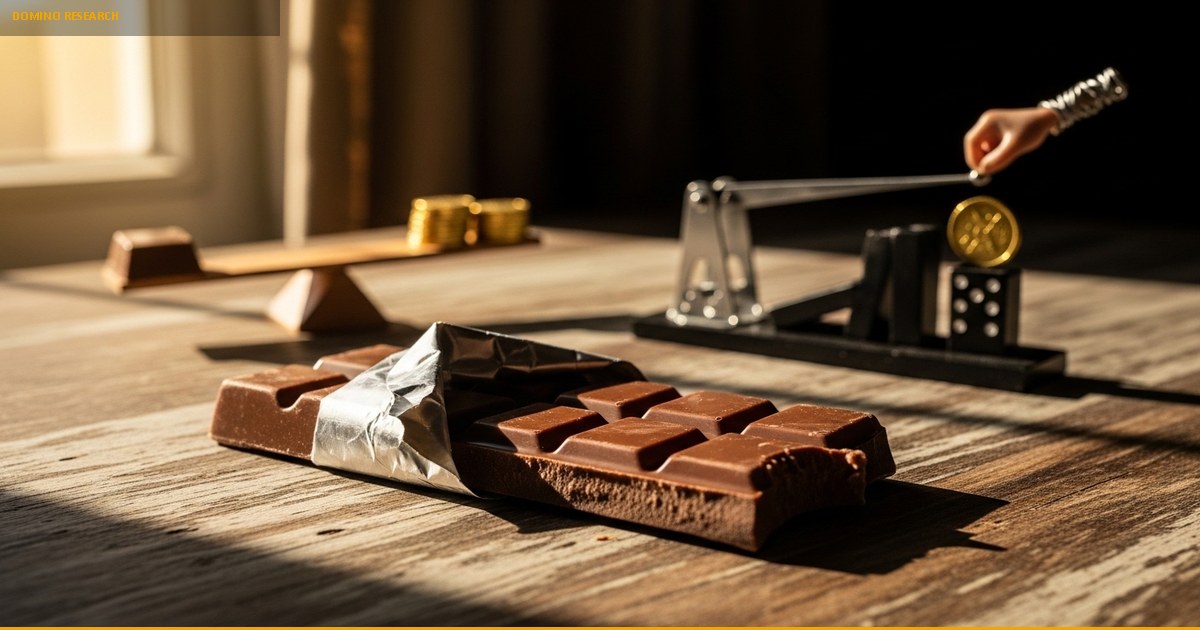
What makes this interesting isn't just the price of your next candy bar. It's the chain of consequences most people aren't tracking — from smuggling networks in Ivory Coast to the inflation data that central bankers obsess over. Let's walk through the dominoes.
Cocoa trees take years to mature. There is no quick fix. The supply crisis is structural.
What just happened
Cocoa prices have hit record highs as West African yields continue to decline. Ivory Coast and Ghana together produce nearly 60% of the world's cocoa each year. When those two countries underperform, there's no backup plan.
You can't just plant cocoa trees somewhere else and harvest beans next quarter. Cocoa trees take several years to mature — meaning supply-side fixes are inherently slow.
The latest spike — roughly 11% — extends a pattern of record-setting price moves building since at least early 2024. This isn't a one-day blip caused by a weather scare. It's a structural supply problem with no quick fix.
First domino: The hedging cliff hits chocolate makers at a predictable moment
Cocoa beans are the single most important raw material for chocolate manufacturers. Companies like Hershey, Mondelez, and Nestlé hedge their cocoa purchases months in advance through futures contracts. But hedging only delays the pain — it doesn't eliminate it.
The key detail: hedge books roll over on a schedule disclosed in company filings. As older, cheaper contracts expire and get replaced at today's elevated prices, the cost increase hits the income statement in a concentrated window. Investors watching quarterly gross margin (revenue minus the direct cost of goods, as a percentage) can pinpoint when the compression arrives.
The response playbook is already visible. Package sizes have been shrinking — a strategy known as shrinkflation — and selective price hikes have appeared across retail channels. But there's a ceiling. In markets like the UK, chocolate unit prices have crossed thresholds that historically trigger consumers to switch to private-label alternatives. That makes this cycle different from past ones. Once a shopper finds a store-brand substitute, they tend to stick with it — even after input costs come back down.
Second domino: A smuggling boom across West Africa
Both countries set guaranteed farmgate prices through their cocoa boards (the CCC in Ivory Coast and COCOBOD in Ghana). These boards were designed to protect farmers from price crashes. But in a price surge, they create a perverse incentive: the government captures the windfall; the farmer doesn't, so the farmer smuggles.
This matters for markets because smuggling distorts the official supply data that traders rely on. If beans are leaving Ivory Coast off the books, the country's reported exports are too low. That makes the supply picture look even tighter than it really is.
That feeds more panic buying, which pushes prices higher, which incentivizes more smuggling. It's a feedback loop — and it's the mechanism that makes this rally self-reinforcing in a way that pure weather-driven spikes are not.
If your government says your crop is worth a fraction of what a buyer across the border will pay, you find a way to get it there.
Third domino: Cameroon's surprise economic windfall
In the most recent quarter (Q1 2025), that shift cut Cameroon's trade deficit by 88%. A country primarily known as an oil exporter saw cocoa overtake petroleum as its top foreign-exchange earner.
Higher export prices make it easier for a country to pay off foreign-currency debt and keep its currency stable. For Cameroon, the windfall matters right now. Stronger export revenue takes pressure off the CFA franc and could reduce the country's need for IMF support. If sustained, it changes how creditors assess Cameroon's sovereign risk profile.
But the benefit is fragile. If cocoa prices eventually crash, Cameroon's trade balance snaps back to its old shape. And even while prices are high, smuggling from neighboring countries can reduce the share of cocoa revenue that the government actually captures. The windfall is real, but it's built on a volatile foundation — and the country's fiscal planning shouldn't assume it persists.
Fourth domino: Child labor scrutiny comes back into focus
During the 2018/19 cocoa-growing season — the most recent period with verified data — 1.48 million children were engaged in hazardous work on cocoa farms in Ivory Coast and Ghana. That includes working with sharp tools, handling agricultural chemicals, and carrying heavy loads. More recent studies are pending, but no evidence suggests the problem has improved.
The cause-and-effect here is simple and well-documented. When the government-set price paid to farmers doesn't keep up with the rising cost of living, farmers cut costs wherever they can. During the 2018/19 season, the surge in child labor coincided with a period of stagnant farmgate prices and rising input costs — a pattern that's repeating now.
For major chocolate brands, this creates a growing ESG risk. Renewed media attention to child labor in cocoa supply chains could mean higher compliance costs, supply chain audits, and reputational damage. Companies that can't demonstrate clean sourcing may face pressure from institutional investors and regulators alike.
Fifth domino: Cocoa as a leading indicator for the broader food-commodity cycle
Rising food prices flow straight into the CPI (consumer price index — the main inflation gauge) (consumer price index — the main inflation gauge). Those are the numbers central banks watch when deciding whether to cut rates. In Europe, where chocolate is a cultural staple, candy and sweets carry real weight in the CPI basket. That makes cocoa more macro-relevant for the ECB than for the Fed.
If cocoa's move is part of a broader soft-commodity cycle — rather than an isolated supply shock — it could complicate the timeline for rate cuts that markets have been pricing in. Central bankers don't want to cut rates while food prices are accelerating. It risks shaking loose the public's belief that inflation will stay under control.
This is a leading-indicator argument, not a prediction. One commodity doesn't make an inflation trend. But cocoa's deep supply problems — aging trees, government price distortions, and no quick replanting fix — mirror what's happening in other agricultural markets. The pattern is worth monitoring alongside upcoming CPI prints in Europe and emerging markets.
The last time this happened
The closest structural parallel isn't the recent cocoa rally — that's a continuation of the current crisis, not a precedent. The better analog is the palm oil squeeze of 2021–2022.
In that episode, Indonesia and Malaysia — which together controlled roughly 85% of global palm oil supply — faced a similar dynamic. Government export restrictions and price controls created smuggling incentives. Official export data understated actual flows. Traders, relying on distorted data, bid prices higher than fundamentals warranted. The feedback loop between policy distortion and market panic drove palm oil futures to record highs.
The resolution took longer than anyone expected. Supply-side fixes were slow because palm trees, like cocoa trees, take years to reach productive maturity. Prices stayed elevated for over a year after the initial spike. Companies that hedged early survived; those that didn't faced brutal margin compression.
Here's the key lesson. When two countries control supply and their governments cap prices, smuggling takes off. Official data stops being trustworthy. And bad data lets rallies run way longer than actual supply and demand would support. That's exactly the setup in cocoa today.
What could go wrong with this thesis
Demand destruction kicks in faster than expected. If chocolate prices rise enough, consumers simply buy less. A sharp drop in global chocolate demand — particularly in price-sensitive emerging markets — could cap cocoa's upside before the supply picture improves.
A strong mid-crop surprises to the upside. Ivory Coast's mid-crop harvest (typically April–September) has been the swing factor in recent years. Over the past three seasons, mid-crop output has averaged roughly 400,000–500,000 tonnes. A print meaningfully above that range would signal yield recovery and could trigger a sharp selloff in cocoa futures.
Hedging proves more effective than expected. If Hershey's and Mondelez's hedge books extend further into 2026 than their public disclosures suggest, the margin-compression timeline gets pushed back — and the stock-price impact may be milder than bears expect. Stable or expanding gross margins in upcoming earnings reports would be the clearest signal.
Government price adjustments reduce smuggling. If Ivory Coast or Ghana raise their farmgate prices closer to world levels, the smuggling incentive shrinks — and with it, the data-distortion feedback loop that's amplifying the rally.
Watchlist
| Ticker | Level | Status | Why |
|---|---|---|---|
| HSY | Current levels | monitoring for margin compression | Hershey is the purest-play large-cap chocolate stock. Cocoa is its biggest input cost, and the hedge-rollover schedule means cost increases hit the income statement on a predictable timeline disclosed in company filings. |
| Confirms: HSY below $155 by June 30, 2026, or Q2 2026 gross margin contracts more than 50 basis points year-over-year = margin compression thesis playing outBreaks: HSY above $185 with cocoa futures still above $8,000/ton = company successfully passing costs through; posture shifts from bearish to neutral | |||
| MDLZ | Current levels | monitoring for relative resilience | Mondelez owns Cadbury and Toblerone but has a more diversified snack portfolio than Hershey, giving it more room to absorb cocoa cost pressure. The comparison between HSY and MDLZ gross margin trends isolates how much cocoa exposure matters versus portfolio diversification. |
| Confirms: Q2 2026 gross margin contracts more than 100 basis points vs Q2 2025 = cocoa costs flowing through despite diversificationBreaks: Q2 2026 gross margin flat or expanding = hedging and pricing power neutralizing cocoa impact; shift to neutral | |||
| HSY | Use ICE cocoa front-month futures as the direct price signal (no active cocoa ETN currently trades; the iPath Bloomberg Cocoa ETN ceased operations in June 2023) | watching cocoa futures directly | For investors who want direct cocoa price exposure, the most liquid instrument is ICE cocoa futures. There is no active, widely-traded cocoa ETF or ETN available as of mid-2025. Investors without futures access can track the ICE cocoa front-month contract as a signal for the thesis. |
| Confirms: ICE cocoa front-month above $10,000/ton through Q3 2026 = supply shortage narrative intensifyingBreaks: ICE cocoa front-month below $7,500/ton within 60 days = demand destruction or supply recovery undermining the rally; reassess entire thesis | |||
Get the weekly digest
One email every Saturday. New stories, new research, no upsell. Unsubscribe with one click.