What to know
- On October 17, 1973, ten Arab oil ministers in Kuwait raised oil prices 70 percent and embargoed the US — within five months crude went from $3.01 to $11.65 a barrel, a quadrupling that rewrote every industrial economy.
- American gas stations ran dry, the Dow lost 45 percent over 21 months, Nixon banned Sunday gasoline sales — and Henry Kissinger asked the Pentagon to draw up plans for a Saudi Arabian invasion (Operation Dhahran).
- Kissinger averted the invasion by inventing the petrodollar: Saudi Arabia would price oil only in dollars and recycle the revenue into US Treasury bonds, in exchange for American security guarantees that still anchor Gulf policy in 2026.
On the morning of October 17, 1973, ten oil ministers from the Arab member states of OPEC sat down in a conference room at the Sheraton Hotel in Kuwait City. They had two pieces of information that the rest of the world did not yet have. First, the war that had begun eleven days earlier — Egypt and Syria's attack on Israel on Yom Kippur — was going badly for the Arab side. Israel had pushed across the Suez Canal and was marching on Damascus. Second, the United States had just announced a $2.2 billion military aid package to Israel: rifles, ammunition, replacement aircraft, the works.
The ministers had been meeting for two days. They had already, the day before, voted to raise the posted price of Saudi Light crude — the global benchmark — by 70 percent, from $3.01 to $5.11 a barrel. That was historic on its own. The major oil companies, which had set posted prices for half a century, had been informed, not consulted.
The second decision, on the morning of the seventeenth, went further. The ministers announced a 5 percent monthly cut in oil production until Israel withdrew from the territories occupied in 1967. Two days later they added a complete embargo against the United States, the Netherlands, Portugal, Rhodesia, and South Africa.
For the next twelve days, the world's largest economy — which got 36 percent of its energy from oil and was importing more of it than it had ever imported before — would receive nothing from the Arab states.
What 36 Percent Looks Like When It Stops
By 1973, the United States imported a third of its oil and used oil for everything. Cutting it off meant cutting off the country.
Americans in 1973 used 17 million barrels of oil a day. That sounds large, but it's the per-capita number that captured what the embargo meant: roughly 30 barrels a year for every man, woman, and child in the country, compared to 6 in France and 2 in Japan. The car-and-suburb model that had defined American life since 1945 — built by Eisenhower's interstate highway system, financed by GI Bill mortgages, sustained by gasoline at 36 cents a gallon — depended on cheap oil being available, always.
It had been available. From 1948 through 1972, the price of Arabian Light crude had hovered between $1.80 and $2.50 a barrel. Adjusted for inflation, oil in 1972 was cheaper than it had been at the end of World War II. American domestic production peaked in 1970 — the so-called Hubbert peak — and from that year forward, the share of oil that had to be imported rose sharply. By 1973, imports were 36 percent of consumption, up from 21 percent five years earlier. About 12 percent of all American oil came from Arab states.
The pricing system worked like this. Posted prices — the prices listed at the wellhead — were set by a cartel of seven major oil companies, the so-called Seven Sisters: Exxon, Mobil, Chevron, Texaco, Gulf, Royal Dutch Shell, and BP. The Sisters had been refining and selling Middle Eastern oil since the 1920s under long concessionary agreements. The producing countries — Saudi Arabia, Iran, Kuwait, Iraq, Venezuela — collected royalties and taxes. They did not, in any meaningful sense, control the resource that came out of their own ground.
OPEC had been formed in 1960 to challenge this arrangement. For the first thirteen years it had been mostly a debating society. The 1973 war changed that.
Eleven Days at the Front
Egypt and Syria attacked at 2 p.m. on Yom Kippur. By the eleventh day, Israel had counterattacked across the Suez and was 60 miles from Damascus.
On October 6, 1973, at 2:00 p.m. local time, Egyptian and Syrian forces simultaneously attacked Israel — Egypt across the Suez Canal into the Sinai, Syria into the Golan Heights. It was Yom Kippur, the holiest day in the Jewish calendar. Israeli reservists were home praying. The attack was the most coordinated in Arab military history.
The first three days nearly ended the war. Egyptian forces breached the Bar-Lev Line — Israel's defensive system on the east bank of the canal — and pushed five miles into the Sinai. Syrian armor reached within ten miles of the Israeli border on the Golan. Israeli losses were severe. Prime Minister Golda Meir, in a private cable to Washington, said the country might fall.
What saved Israel was the airlift. Beginning on October 14, the Nixon administration authorized Operation Nickel Grass — an emergency military airlift of weapons, ammunition, and replacement aircraft. Over the next 32 days, the United States Air Force flew 567 missions and delivered 22,000 tons of supplies. The airlift was visible from the runways of Lod Airport in Tel Aviv. Israeli forces, resupplied, counterattacked. By October 17, they had crossed the Suez Canal in the south and surrounded Egypt's Third Army. By October 21, they were 60 miles from Damascus.
The Arab oil ministers in Kuwait City watched the airlift on television. The decision to weaponize oil had been gestating for months — King Faisal of Saudi Arabia had warned American oil executives in May 1973 that he would do exactly this if the United States did not pressure Israel into territorial concessions — but Nickel Grass made it inevitable. Faisal told his nephew, Saudi Oil Minister Ahmed Zaki Yamani, that the time had come.
King Faisal told his nephew, Saudi Oil Minister Ahmed Zaki Yamani, that the time had come.
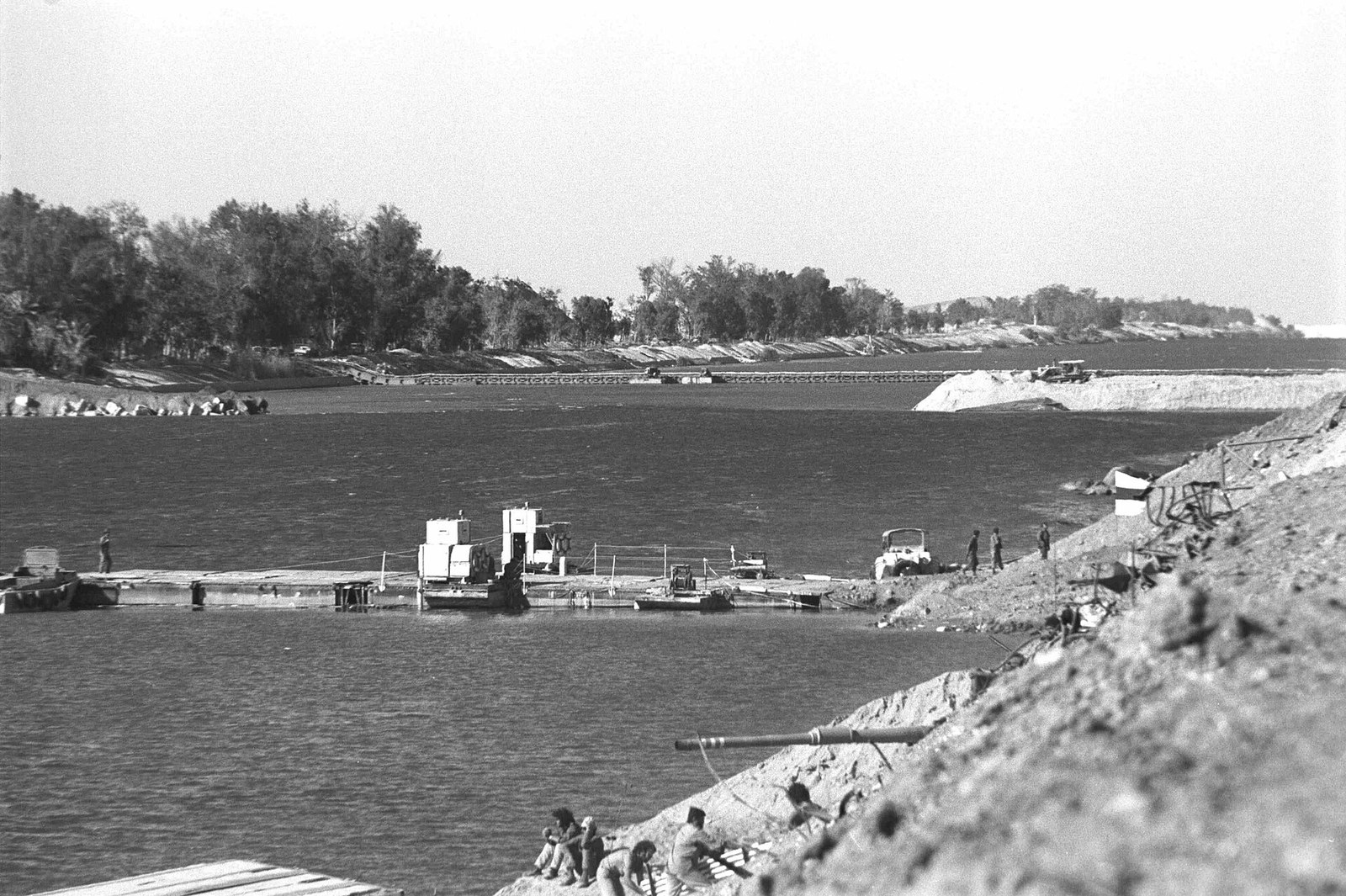
Israeli forces crossed the Suez Canal on October 17, 1973 — the same day the Arab oil ministers met in Kuwait City. (Photo: Unknown authorUnknown author / Public domain)
Twelve Days, Then Five Months
The embargo's first phase lasted twelve days. The price shock that followed lasted forty years.
The full embargo was announced on October 19, 1973, after Nixon publicly committed the $2.2 billion aid package. From that day until November 1, the Arab states shipped no oil at all to the United States, the Netherlands, Portugal, Rhodesia, or South Africa. The Netherlands was on the list because Rotterdam was Europe's largest oil port and Dutch policy had been pro-Israel. Portugal was on the list because the Lajes Field on the Azores had been used by American transport aircraft for the airlift refueling.
For twelve days, no Arab oil reached American refineries. American refineries had roughly 30 days of working inventory. The market caught on slowly. By the third week of October, spot prices in Rotterdam had jumped from $5 a barrel to $15. By December, traders were paying $17. By the time OPEC's December 23 meeting in Tehran ended, the official posted price had been raised to $11.65 — nearly four times what it had been in early October.
The physical embargo against the United States ended on March 18, 1974, after Kissinger had negotiated a partial Israeli withdrawal in the Sinai. The five-month duration was, in retrospect, brief. The price shock was permanent. Adjusted for inflation, oil never returned to its pre-1973 levels. The cheap-oil economy that had built postwar America died on October 17, 1973, in a Sheraton conference room in Kuwait City, and what replaced it was a structurally more expensive, structurally more politically hazardous energy system that the world is still living with.
The immediate impact on American daily life was sharper than the price chart suggested. Refineries optimized for steady throughput could not absorb the supply shock. By November 1973, gas stations in California, New York, and New England were running dry. Lines stretched a mile from open pumps. Some stations posted hand-written signs saying NO GAS for days at a time. Nixon, on November 7, addressed the nation and ordered a national 55-mile-per-hour speed limit, banned Sunday gasoline sales for non-emergency vehicles, and asked Americans to lower their thermostats to 68 degrees and run on daylight saving time year-round. He created the Federal Energy Office to allocate gasoline by region. By the spring of 1974, four hundred American stations a day were running dry.
Operation Dhahran
Henry Kissinger asked the Pentagon to draw up plans for a Saudi Arabian invasion. The plans existed. They were never used.
On December 21, 1973, two months into the embargo, Henry Kissinger — Secretary of State and National Security Adviser — held a meeting in his office in the West Wing with three colleagues. The notes from that meeting, declassified in 2004, recorded a question: was a military takeover of Saudi oil fields feasible? Kissinger asked the Pentagon to draw up plans.
The planning was real. Operation Dhahran — named for the eastern Saudi city near the Ghawar field, the largest oil reservoir in the world — would have used the 82nd Airborne to seize the wells and export terminals at Ras Tanura, with follow-on Marine forces from the Sixth Fleet. The CIA estimated the operation could secure 50 percent of Saudi production within seven days. The Saudis themselves had a different estimate. King Faisal had reportedly told a CIA station chief that if American troops landed on his soil, his last order would be to dynamite the wellheads. Saudi engineers had been pre-positioning explosives at major facilities since the embargo began. The wells, once destroyed, would take five to seven years to restore.
Kissinger wrote later that he never seriously intended the invasion. He intended for the planning to leak — and it did, to The Times of London in January 1975, more than a year after the embargo had ended. The leak was almost certainly a controlled signal. It told Riyadh that Washington had reached the limits of its patience. It did not need to be acted on; the threat itself was the message.
What actually came out of the December 1973 meeting was something more durable than an invasion. Kissinger and Treasury Secretary William Simon began to design an alternative. If the Saudis would price all oil exports in dollars — making the dollar the world's reserve currency for energy at exactly the moment the gold standard had ended — and if they would recycle their oil revenue into U.S. Treasury bonds, then in exchange the United States would provide security guarantees, military equipment, and tacit acceptance of the new pricing. The deal was struck in two trips Simon made to Riyadh in July and September 1974. It was never written down as a treaty. It is sometimes called the petrodollar arrangement, and it is one of the most important uncodified agreements in modern American foreign policy.
Kissinger asked the Pentagon to plan an invasion of Saudi oil fields. The Saudis pre-positioned explosives at the wellheads. (Photo: John C. Tarvin / Public domain)
The Petrodollar
Saudi Arabia agreed to price oil in dollars and park the proceeds in US Treasuries. In return: American security and the right to set the world's oil price.
The petrodollar arrangement that emerged from 1974 was, on paper, a series of bilateral commercial agreements. Saudi Arabia would buy U.S. Treasury bonds at what were called add-ons — direct purchases at the auction price, without going through the Federal Reserve's primary dealer system. The amounts were kept confidential. The Saudis did this for forty-two years; the holdings were finally disclosed for the first time in May 2016. They held more than $116 billion in Treasuries.
The first-order effect was that the United States had a guaranteed buyer for its rapidly expanding deficit borrowing in the 1970s and 1980s. Reagan's defense buildup and tax cuts were, in significant part, financed by Saudi oil revenue recycled through the Treasury market. The dollar's status as the world reserve currency, which had been threatened by the end of Bretton Woods in 1971, was reinforced. Every country that bought oil — which is to say, every country — needed dollars to pay for it. The dollar's network effect compounded.
The second-order effect was political. The U.S.–Saudi relationship deepened from a transactional oil-supply arrangement into a structural alliance. American training of the Saudi National Guard, which began in 1973, became a multi-billion-dollar program by the 1990s. American AWACS surveillance aircraft were sold to the Saudis in 1981 over Israeli objections — President Reagan won the Senate vote, and the planes flew over Saudi airspace within months. American air bases in Saudi Arabia, established in 1990 for Operation Desert Shield, became a fixture for a decade until they were withdrawn in 2003 (a withdrawal Osama bin Laden had cited as a personal demand).
The third-order effect was that OPEC continued to set oil prices, formally or informally, for the next four decades. The 1973 embargo had transferred pricing power from the Seven Sisters to the producing states, and it never went back. Even after American shale production transformed the global supply picture in the 2010s, Saudi Arabia and the OPEC+ cartel still set the marginal price. When Mohammed bin Salman cut Saudi production in 2020 to discipline the shale producers — a move that would have been unthinkable for any Saudi king before 1973 — he was operating on the lever the 1973 embargo had handed Riyadh, and that has been there ever since.
When Mohammed bin Salman cut Saudi production in 2020 to discipline the shale producers, he was operating on the lever the 1973 embargo had handed Riyadh, and that has been there ever since.
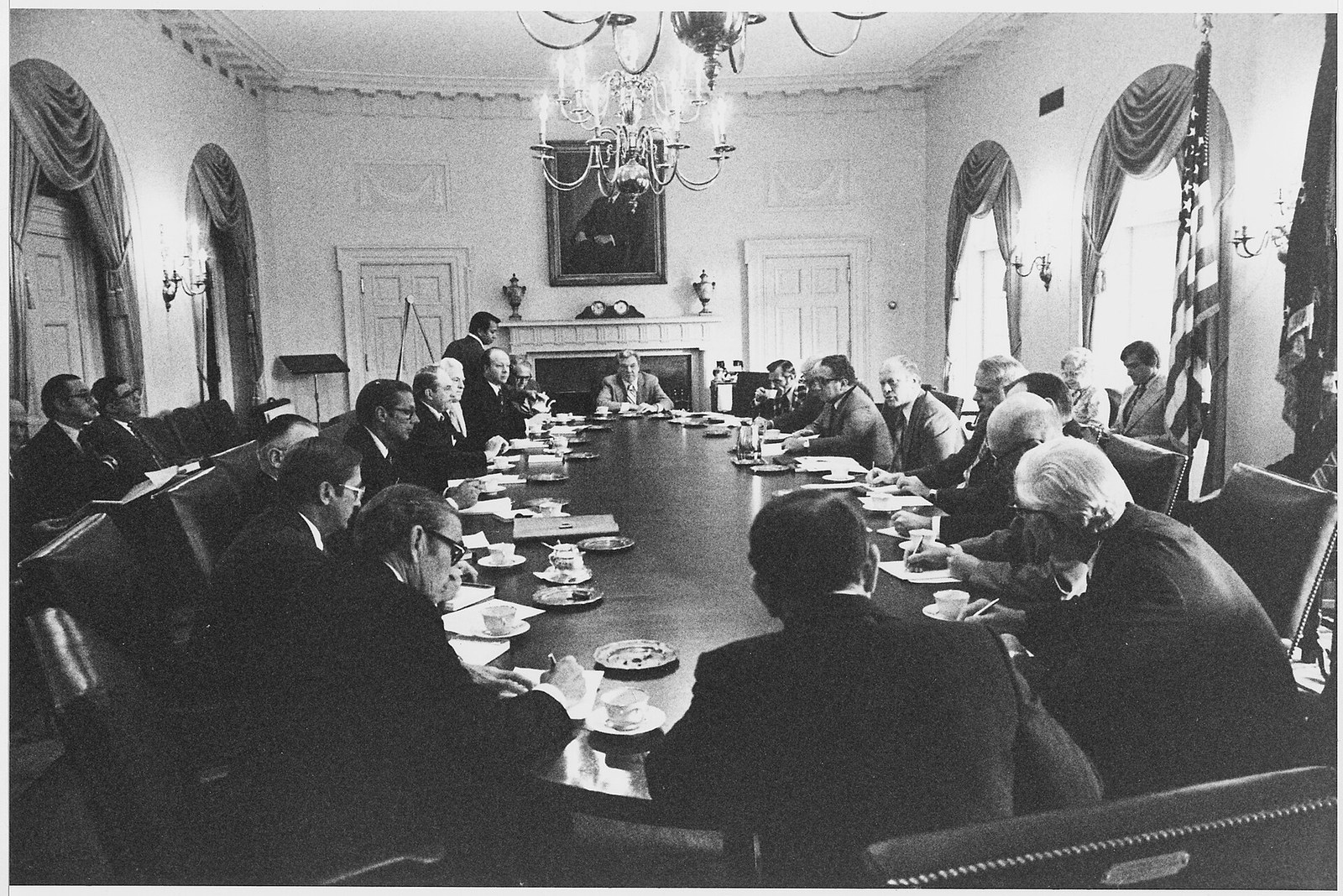
Treasury Secretary William Simon's two trips to Riyadh in 1974 — where the petrodollar arrangement was struck without being written down. (Photo: David Hume Kennerly / Public domain)
What October 1973 Built
Stagflation, the SUV, the Strategic Petroleum Reserve, the Gulf wars — the modern world is downstream of twelve days in Kuwait.
The price of oil never returned to its pre-1973 levels in inflation-adjusted terms. That single fact rewrote the structure of every industrial economy. Cars became smaller — by 1985, the average American car was 30 percent more fuel-efficient than in 1973 — and then, when prices came back down in the late 1980s, larger again. The SUV revolution of the 1990s was a direct consequence of CAFE fuel-economy rules that exempted light trucks; the loophole had been written under embargo conditions when the only thing that mattered was the average car. The unintended consequences ran for thirty years.
Industrial restructuring was sharper. American manufacturing, which had been built around energy intensity (steel mills, aluminum smelters, petrochemicals), shifted toward lower-energy services. Japan, which imported 99 percent of its oil and had been almost uniquely vulnerable to the embargo, became a global leader in fuel-efficient manufacturing — Toyota's just-in-time production system spread globally in the 1980s in part because energy savings were now a real line item.
Monetary policy was upended. The 1970s wage-price spiral that Volcker would eventually break was, in significant part, an oil-price-shock phenomenon. Each round of oil price increase fed wage demands, which fed price increases. Stagflation — the combination of high unemployment and high inflation that economists had previously thought impossible — was largely an artifact of two oil shocks (1973 and 1979).
Geopolitically, every American intervention in the Persian Gulf since 1973 traces back to October's lesson. The Carter Doctrine of 1980, which declared the Persian Gulf a vital U.S. interest, was a direct response. The 1990 Gulf War, when Saudi Arabia accepted half a million American troops on its soil, was the petrodollar contract being honored at scale. The 2003 Iraq War, whatever its other motivations, was conducted with the explicit awareness that disrupting Iraqi oil exports for a sustained period would crash the global economy. The Strategic Petroleum Reserve, which now holds 372 million barrels in four salt domes along the Gulf Coast, was created in 1975 specifically to make a future embargo less effective.
None of this was inevitable on October 6, when the war began. None of it was the plan on October 17, when the ministers walked into the Sheraton in Kuwait City. The embargo was meant to be a tactical pressure on American policy toward Israel. It became, by accident, the founding event of the modern energy economy.
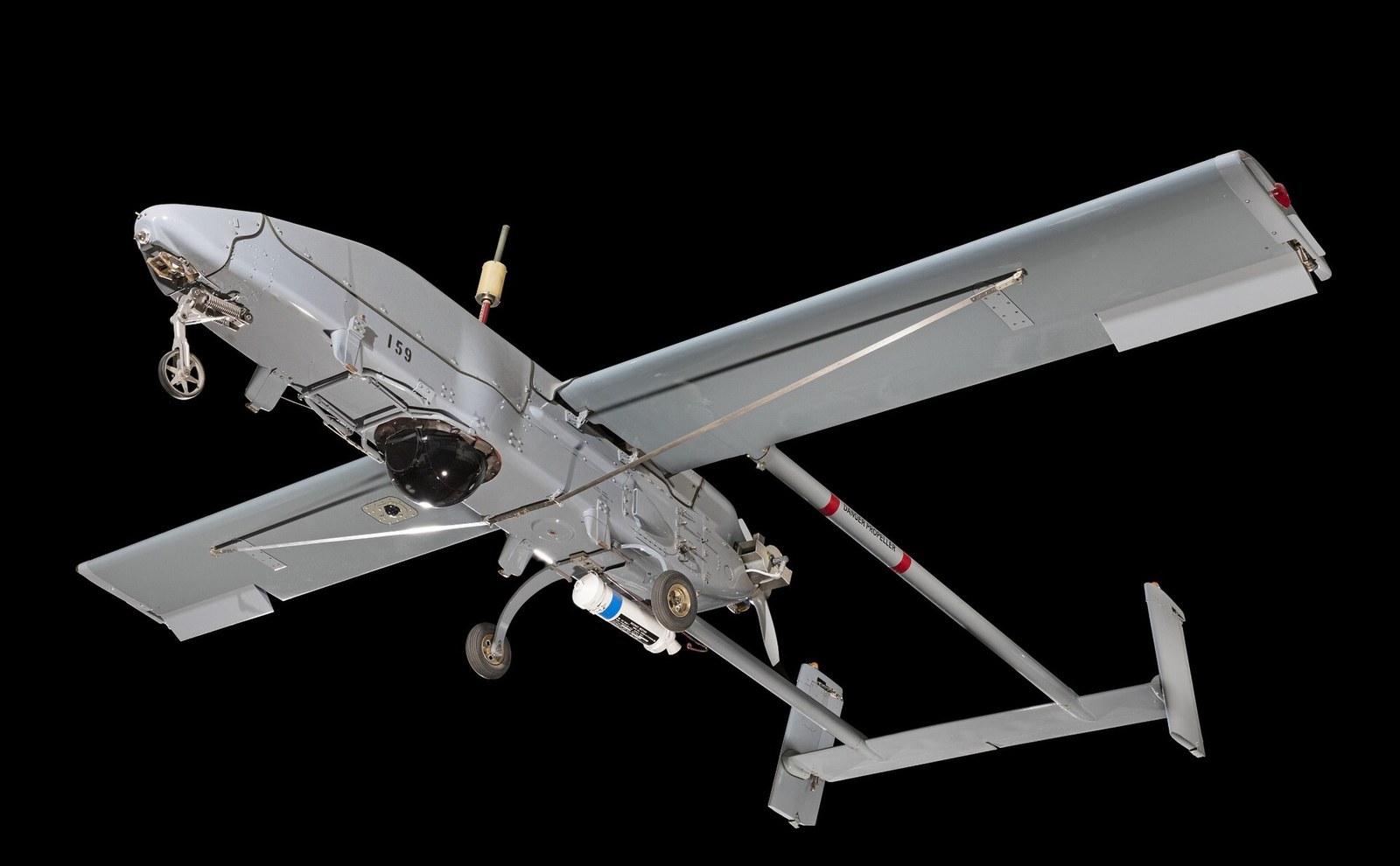
The Strategic Petroleum Reserve, the Carter Doctrine, the 1990 Gulf War — every American intervention in the Persian Gulf is downstream of October 1973. (Photo: Pioneer UAV, Inc / CC0)
What This Story Tells Us Today
The 1973 embargo is the cleanest case in modern history of a small group of producers using control over a critical commodity to reshape the international system. It worked because oil was non-substitutable on any short timeline, because the producers could coordinate, and because the consumers had not built strategic reserves. All three of those conditions had to be true. They were, briefly, in 1973.
The parallels to 2026 are imperfect but real. Critical inputs for the modern economy — semiconductors, rare earths, certain pharmaceuticals, lithium and cobalt for batteries — sit in concentrated production geographies. China refines roughly 70 percent of the world's lithium, 80 percent of its cobalt, and produces 90 percent of the world's permanent magnets. TSMC fabricates more than 90 percent of leading-edge chips. Russia and Ukraine produce a quarter of the world's wheat. None of these chokepoints is currently being weaponized in the way Arab oil was in 1973 — but the conditions that allowed 1973 to happen are present in each of them.
The second lesson is the durability of the institutions an embargo creates. The Strategic Petroleum Reserve was meant to be a temporary buffer; fifty years later, it is still the U.S. government's primary tool for managing oil-supply shocks. The petrodollar arrangement was a 1974 fix; it is still a structural feature of global capital flows. The Carter Doctrine was meant for one moment; it has shaped Gulf policy for forty-five years. When critical-input shocks happen, the responses tend to outlive the shocks by decades.
For the next critical-input shock — and there will be one, in semiconductors or in rare earths or in something less anticipated — the question to ask is not how the immediate disruption will be resolved. It is what the institutional response will be, and how long it will last. October 1973 did not end in March 1974. It is still ending.
Get the weekly digest
One email every Saturday. New stories, new research, no upsell. Unsubscribe with one click.