What to know
- Tensions around the Strait of Hormuz snapped the Nasdaq's longest winning streak in over three decades, triggering broad profit-taking across all three major indexes.
- The non-obvious beneficiary: domestic rare-earth and critical-mineral companies are getting repriced as governments accelerate supply-chain reshoring away from unstable corridors.
- If diplomatic channels reopen within two weeks, the oil fear premium evaporates and every domino below reverses — this trade has a short shelf life.
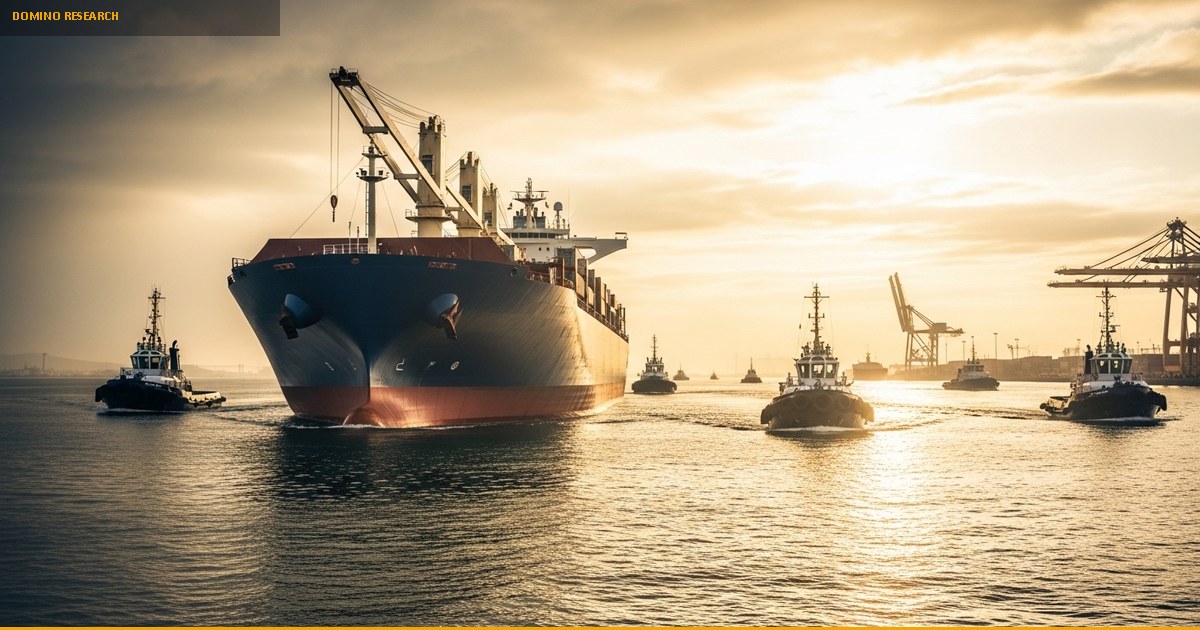
The Nasdaq's longest winning streak in over three decades just died. The culprit: a 21-mile waterway between Iran and Oman called the Strait of Hormuz.
About a fifth of the world's oil passes through it daily. When someone threatens to close it, the global economy doesn't wait for confirmation — it flinches immediately. Futures sell off, oil spikes, and portfolio managers who've been riding momentum for weeks suddenly remember what risk feels like.
That flinch is now rippling through every asset class. The dominoes are already falling.
A 21-mile strip of water between Iran and Oman just ended a stock market rally that hadn't been seen since Bill Clinton's first year in office.
What just happened
The Dow slipped and both the S&P 500 and Nasdaq retreated from record highs as Middle East peace talks appeared to collapse. The Nasdaq's historic winning streak — the longest in over three decades — snapped as tensions around the Strait of Hormuz escalated.
The trigger was specific: the U.S. Seized an Iranian-flagged vessel, directly escalating an already tense standoff over Hormuz shipping lanes. Ongoing oil disruption in the background added pressure to an already fragile tape.
Futures confirmed the mood shift. S&P 500, Nasdaq, and Dow futures all fell as hopes of de-escalation with Iran dwindled. The rally that had been building for weeks hit a wall made of geopolitics and crude oil.
First domino: Oil's fear premium — and who captures it asymmetrically
The ongoing oil disruption directly contributed to the broader market stumble. The U.S. Seizure of an Iranian-flagged vessel escalated the standoff and widened the premium further.
What matters now isn't the obvious play — major oil producers are already well-owned. The asymmetric question is how long the premium persists. In prior Hormuz episodes, including the 2019 Abqaiq drone strike on Saudi facilities, the fear premium faded within two weeks as shipping resumed. If this episode follows the same pattern, the premium is a trade, not a trend.
The names that capture the most upside from a sustained premium aren't the Exxons and Chevrons — they're the smaller, more leveraged energy names and LNG shippers whose margins expand disproportionately when spot prices spike. Watch the second-tier names, not the blue chips.
Second domino: Momentum unwinds — and passive funds are forced to rebalance
The Nasdaq had been on its longest winning streak in over three decades before this pullback. The S&P 500 and Nasdaq both retreated from record levels, meaning enormous unrealized gains were sitting in portfolios, waiting for a catalyst to crystallize.
Geopolitical tension lit the fuse. But the downstream effect goes beyond discretionary selling. Momentum-factor ETFs and systematic trend-following strategies are rules-based: when the trend breaks, they sell automatically. That forced selling creates a feedback loop — prices drop, more signals trigger, more selling follows. This mechanical dynamic is why the shape of the next two weeks matters more than the first day's headline number.
The question isn't whether the bull market is over. It's whether the forced rebalancing creates a buying opportunity for active managers — or whether it cascades into a deeper de-risking event. The answer depends on whether oil stays elevated long enough to change the macro narrative.
Third domino: Defense spending accelerates — but the real edge is in the contract pipeline
Middle East peace talks are now at risk, raising the probability of continued or escalated military engagement. When diplomacy fails, governments fast-track defense procurement — and the specific programs that accelerate matter more than the sector rotation headline.
Watch two budget lines: missile-defense restocking (Iron Dome interceptors, THAAD batteries) and the FY2026 NDAA supplemental. Both could move through Congress faster if the threat picture gets worse. These programs mostly help second-tier defense companies — the ones making components and subsystems. The big prime contractors are already priced for geopolitical tension.
Lockheed Martin, Raytheon, and Northrop Grumman will participate, but their size means the incremental revenue moves the needle less. The less-followed companies further down the supply chain — makers of guidance systems, electronic warfare gear, and precision munitions — are where fewer investors are positioned. That means more upside is still on the table.
The companies that build weapons tend to do well when the world gets more dangerous. It's counterintuitive — but it's one of the most reliable patterns in the market.
Fourth domino: Airlines hit the hedging wall
Jet fuel is one of the largest operating costs for airlines. Oil disruption is ongoing, and if it persists, airlines are among the first casualties — but not all airlines equally.
Most major carriers hedge 40–60% of their fuel costs 12 months forward. The critical question is which carriers hedged aggressively going into this quarter and which didn't. Airlines that locked in lower fuel prices months ago have a cushion. Those that let their hedges expire — or cut coverage to save on costs — are now stuck paying spot prices loaded with a geopolitical risk markup. That divergence in hedging coverage will show up in the next round of earnings calls and forward guidance.
Beyond airlines, higher energy prices reduce disposable income. When people spend more at the pump, they spend less at restaurants, retailers, and entertainment venues. History suggests that if oil disruption extends beyond three to four weeks, consumer spending data starts showing stress. We're watching credit card transaction velocity and weekly gasoline demand as leading indicators.
Fifth domino: The rare-earth and critical-mineral repricing accelerates
The U.S. Imports most of its critical minerals. China dominates processing for many of the materials that go into defense systems and advanced electronics. When geopolitical crises flare up, those supply-chain weak spots stop being a think-tank talking point and start showing up in actual budgets.
The logic is straightforward. If one chokepoint can threaten global oil, every chokepoint becomes a risk to be mitigated. Governments are racing to source critical materials closer to home. The market is repricing companies that own mineral deposits in the U.S. Or allied nations.
This is a longer-term dynamic than the oil fear premium, but it compounds with each successive geopolitical shock. Every Hormuz flare-up, every Taiwan Strait headline, every export-control escalation makes the reshoring thesis stickier. The companies positioned to benefit are those with permitted, production-stage assets in the U.S., Canada, or Australia — not exploration-stage stories with decade-long permitting timelines.
The last time this happened
The closest parallel isn't the April 2025 tariff shock. It's the September 2019 Abqaiq drone strike. Houthi drones hit Saudi Arabia's largest oil processing plant and briefly knocked out roughly 5% of global oil supply. Oil spiked nearly 15% overnight. Markets sold off sharply. And then, within 11 trading days, both oil and equities had fully recovered.
The tariff shock of April 2025 is worth noting for contrast. Starting on April 2, 2025, global stock markets fell sharply after President Trump announced sweeping tariffs on what was termed 'Liberation Day'. That decline became the largest global market drop since 2020. But the mechanics were very different. Tariffs are a lasting cost set by policy. A Hormuz fear premium is based on probability — it can vanish overnight if diplomacy kicks in or ships keep moving freely.
That difference matters for recovery speed. The tariff shock took months to work through because the costs were structural. The Abqaiq recovery took days because the threat was temporary. Our view: this looks more like Abqaiq than Liberation Day. Unless ships actually stop moving — then the timeline stretches out a lot.
What could go wrong
Peace talks resume. If diplomatic channels reopen within two weeks, the fear premium in oil evaporates and the equity sell-off reverses. Defense stocks lose their bid. Observable tripwire: watch for a joint statement from the State Department and Iranian Foreign Ministry, or a UN-brokered ceasefire framework. If either appears, the trade unwinds fast.
Oil disruption stays contained. If Hormuz shipping continues without major interruption and crude falls back to pre-escalation levels within 10 trading days, the supply-risk premium has faded. Airline margins stabilize, consumer spending holds up, and the whole chain unwinds. Watch tanker tracking data and weekly EIA inventory reports for confirmation.
Markets shrug it off. History says this is possible — the Abqaiq recovery took just 11 days. If the Nasdaq reclaims its 20-day moving average within two weeks, the momentum-unwind thesis is invalidated and systematic buyers re-enter. Geopolitical shocks historically trigger one-to-two-week sell-offs before markets refocus on fundamentals.
Credit conditions tighten on leveraged deals. If risk-off sentiment deepens, companies that recently announced large leveraged acquisitions could face additional pressure as credit spreads widen. That's a secondary risk worth tracking — watch high-yield spreads and new-issue pricing for signs of contagion.
We assign roughly 60% probability to a one-to-two-week extension of the pullback; 40% to a quick reversal. That 40% tail risk deserves attention — it's the scenario where acting on the fear premium costs you money.
Watchlist
| Ticker | Level | Status | Why |
|---|---|---|---|
| USO | Watch for a sustained weekly close above recent highs within 3 weeks | approaching | U.S. Oil Fund — the most direct way to track whether the Hormuz fear premium sticks or fades. If USO fails to hold elevated levels within three weeks, the premium has dissipated and the downstream domino chain weakens. |
| LMT | Watch for new highs on contract announcement catalysts | approaching | Lockheed Martin — the biggest U.S. defense contractor. The edge isn't the sector rotation (already crowded) but whether specific procurement accelerations (Iron Dome replenishment, THAAD orders) show up in backlog guidance. |
| RTX | Watch for new highs on Middle East contract flow | approaching | RTX (Raytheon) — significant exposure to missile defense systems and jet engines, both directly sensitive to Middle East escalation. Monitor for contract acceleration announcements and supplemental defense budget markups. |
| DAL | Watch for breakdown on forward guidance revisions | approaching | Delta Air Lines — a canary for airline margin pressure from rising jet fuel costs. The key variable is hedging coverage: if Delta's next earnings call reveals lower-than-expected fuel hedging, the margin compression thesis accelerates. |
| GLD | Watch for breakout above recent range on sustained risk-off flows | approaching | Gold ETF — safe-haven flows accelerate when equities pull back from records and geopolitical risk rises. Gold wasn't a primary domino in this chain, but it's the clearest read on whether institutional money is positioning for sustained uncertainty or a quick reversal. |
Get the weekly digest
One email every Saturday. New stories, new research, no upsell. Unsubscribe with one click.