What to know
- Pop Mart lost $33 billion in market value after revealing heavy revenue concentration in a single toy line.
- The creator of Labubu now holds enormous leverage over a company that can't survive without him.
- The selloff repriced Sony's film deal in real time — and may have handed Sony better backend terms on the most valuable toy IP in Asia.
A fuzzy elf toy called Labubu just wiped $33 billion off a publicly traded company. Not because demand collapsed — but because investors finally saw where the money actually came from.
Pop Mart, the Chinese collectibles company behind Labubu, reported strong earnings. But the results revealed that a growing share of revenue traces back to a single IP line. The market repriced the stock immediately, shaving more than 22% in one session.
The question now: can one toy line sustain a company valued north of $50 billion when every investor in Asia just learned it's the only thing that matters?
The answer has implications that go way beyond Pop Mart.
What just happened
Pop Mart, the Chinese company behind the blind-box collectible craze, saw its stock plunge over 22% in a single session. The trigger wasn't bad earnings — the results were actually strong. The problem was what the results revealed: a heavy concentration of sales in Labubu, a single toy line.
The market's reaction was swift. Pop Mart shed roughly $33 billion in market value in the days following the disclosure.
The timing made it worse. Investors were still processing the concentration risk. Then Pop Mart announced two big bets: a lease on New York's Fifth Avenue and a deal with Sony to make a Labubu feature film. To some, that looked like doubling down on the very thing the market was worried about.
First domino: The disclosure gap
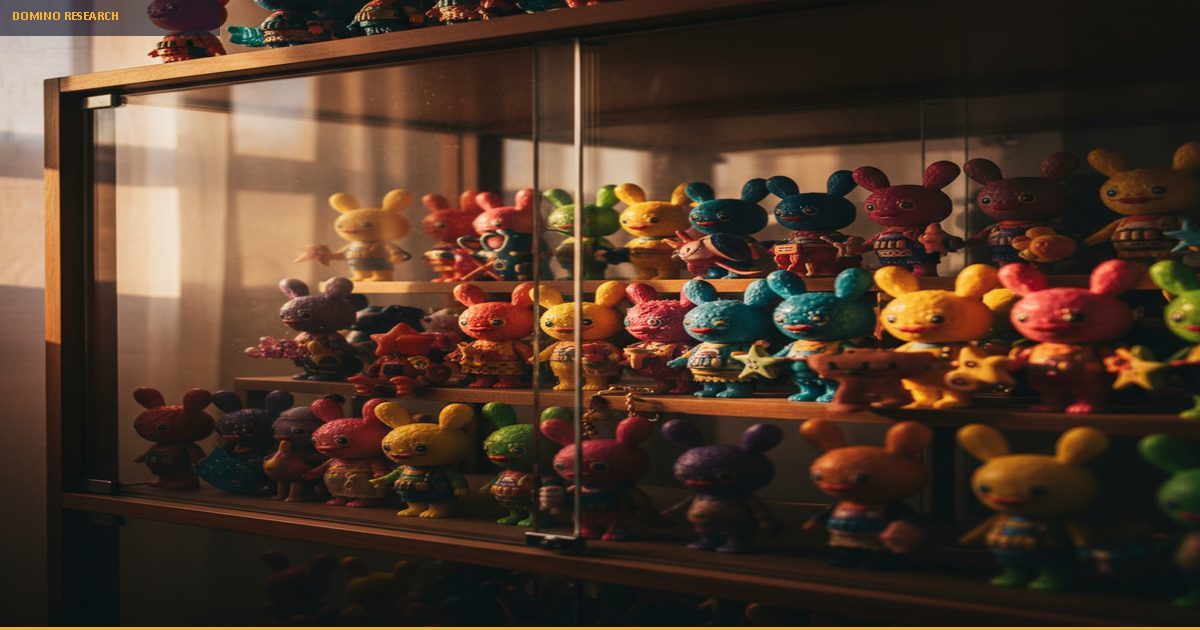
Pop Mart revealed that the bulk of its sales come from Labubu, a line of collectible plush elves sold in sealed blind-box packaging. The company licenses other brands — Disney, Harry Potter, Care Bears — but none move the needle the way Labubu does.
What caught the market off guard was the reporting structure. Pop Mart's segment disclosures had allowed investors to treat the company as a diversified platform with multiple growth engines. The earnings release punctured that framing. Until the concentration data came out, Wall Street analysts assumed the company had a balanced portfolio. It didn't.
This keeps happening with fast-growing Chinese consumer companies. Their financial reports hide how much they depend on a single product. Then one filing reveals the truth, and investors have to rethink the whole story overnight. Pop Mart's disclosure didn't reveal a new problem. It revealed an old one that the reporting structure had been hiding.
That concentration risk leads directly to the next question: who actually owns Labubu?
Pop Mart's Licensing Portfolio
| IP Line | Creator/Owner | Revenue Impact |
|---|---|---|
| Labubu | Kasing Lung | Majority (concentration risk) |
| Disney | Disney | Minor contributor |
| Harry Potter | Warner Bros. | Minor contributor |
| Care Bears | Cloudco Entertainment | Minor contributor |
Second domino: Kasing Lung holds the cards
Labubu wasn't invented by Pop Mart. It was created by Kasing Lung, a Hong Kong illustrator who originally introduced the character in his series The Monsters. Lung has released over 300 different character designs. Pop Mart holds exclusive production and distribution rights.
Before the earnings disclosure, this was a balanced partnership. Now it's a power imbalance. When a company's entire valuation rests on one external IP, the person who owns that IP gains enormous negotiating leverage.
Lung could demand richer royalties. He could explore licensing deals with competitors. He could simply slow down. No public filing details the specific terms of their agreement — meaning investors can't even model the renewal risk. Pop Mart needs Labubu far more than Lung needs Pop Mart, and the whole market now knows it.
That leverage shift doesn't just affect Pop Mart. It ripples into the deal that was supposed to be Pop Mart's insurance policy.
Third domino: Sony's movie deal just got cheaper
Pop Mart and Sony announced a partnership to produce a Labubu feature film. The playbook is familiar — Mattel's 2023 Barbie film proved that a well-executed movie can extend a toy brand's cultural shelf life by years.
Pop Mart negotiated this deal at peak valuation. Sony now has better leverage. That matters because toy-to-film deals live or die on the backend. Who gets what cut of merchandise sales? Who controls sequel rights? How do they split international distribution money? A weaker Pop Mart likely concedes more on all three.
For Sony, this could be a low-risk option on a global franchise. An animated feature's budget is small compared to Sony Pictures' typical slate. And if Labubu's cultural moment holds, the merchandise revenue could be enormous. Sony may have accidentally timed the best deal in its animation pipeline.
Pop Mart's Fifth Avenue lease suggests the company is betting heavily on the movie's success, planting a flag in the most expensive retail corridor in the world. But a movie takes years to produce. Pop Mart needs Labubu to stay hot until then. That's the gap the market is pricing in.
Fourth domino: The blind-box category loses its proof point
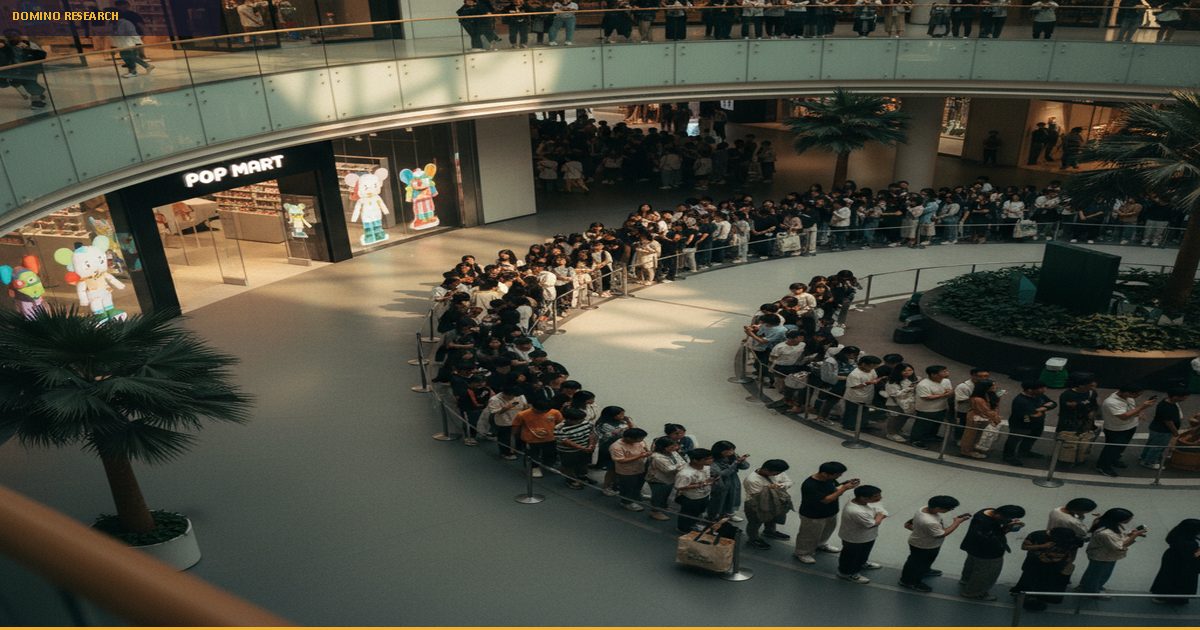
The Financial Times said Pop Mart turned toy-buying into "an act of trendy connoisseurship" among China's young, wealthy consumers. Pop Mart is a leading Chinese toy company known for selling collectible toys and figurines in a blind-box format. It was the category's best proof point — the company VCs cited when pitching collectible-toy startups, and the comp retailers used when allocating shelf space.
When the category leader's stock drops 22% on trend-durability concerns, it sends a signal to the entire market. Competitors like Tokidoki, Sonny Angel's parent company Dreams, and Kidrobot now face tougher talks with retail buyers. Those buyers were already skeptical that blind-box toys could last.
The downstream effects are concrete. Venture-backed collectible startups approaching Series B rounds just lost their best comparable. Retail partners evaluating blind-box shelf space for the next buying cycle now have a data point that says the category's biggest winner was a single-product story. The funding environment for the entire niche just got meaningfully tighter.
Fifth domino: The resale paradox
The mystery element of blind-box packaging fuels an active secondary market where rare Labubu versions trade at steep premiums. If Pop Mart's financial pressure causes it to become more conservative with production runs — fewer new releases, smaller batches — the supply of new figures could tighten.
When supply contracts but cultural demand persists, resale prices tend to climb. That's good news for collectors sitting on rare Labubus. It's less good for Pop Mart, which doesn't capture any of the secondary-market upside. The company makes money on the first sale. After that, the value flows to resellers and speculators.
So the same crisis hurting Pop Mart's stock could end up making existing toy owners richer. That creates a feedback loop: the brand feels more exclusive even as the company struggles. For investors, the signal to watch is resale premiums on platforms like StockX and Xianyu: if premiums hold above roughly 1.3x retail, primary demand is intact. If they compress below that, the cultural moment is fading.
The last time this happened
Beanie Babies prove the fragility of collectible crazes: peak mania in the late 1990s gave way to permanent demand collapse. Ty Inc. survived, but the secondary market evaporated and the brand never recovered its cultural relevance.
But Pop Mart's risk profile is actually different — and arguably worse. Ty owned its IP outright. Kasing Lung owns Labubu. Ty's problem was demand evaporation. Pop Mart faces that plus licensor dependency, a combination that compounds the downside.
A less obvious parallel is Crocs between 2007 and 2009. Crocs had a single-silhouette concentration problem — one shoe drove the vast majority of revenue. The stock fell over 95% from peak to trough. Crocs eventually survived by licensing aggressively and diversifying its designs. But it took nearly a decade. Pop Mart's Sony deal is an attempt to compress that timeline. The question is whether the market will give them the runway to execute.
What could go wrong
Collectible demand fades permanently. Labubu could follow the Beanie Babies arc — white-hot demand followed by permanent collapse. The signal to watch: if Labubu's share of Pop Mart revenue exceeds 45% in the next semi-annual HKEX filing, concentration is worsening, not stabilizing. If secondary-market resale premiums on StockX or Xianyu fall below roughly 1.3x retail price, primary demand is softening.
Kasing Lung walks. If the creator of Labubu decides to license the character elsewhere — or simply stops producing new designs — Pop Mart loses the one thing holding its business together. Pop Mart hasn't disclosed the license's length or renewal terms. That makes this risk impossible to model — and critical to watch. Watch for any Lung-affiliated IP announcements outside the Pop Mart ecosystem.
The movie stalls. Not every toy-to-film adaptation works. The Emoji Movie and Playmobil prove that a recognizable brand doesn't guarantee a good movie. The specific trigger: if the Sony deal is not greenlit to active production within 18 months of announcement, the franchise bet is stalling and the bridge strategy is failing.
China's consumer slowdown deepens. Pop Mart's core customer base is young, affluent Chinese consumers. If discretionary spending contracts further, collectible toys are among the first purchases to get cut. Monitor Pop Mart's same-store sales growth in mainland China stores as the leading indicator.
The Fifth Avenue bet backfires. Premium retail leases are expensive and long-term. If foot traffic disappoints, the New York store becomes a drag on margins at exactly the wrong time. The store's performance will show up in Pop Mart's international segment within two to three quarters of opening.
Watchlist
| Ticker | Level | Status | Why |
|---|---|---|---|
| 9992.HK | Watch for stabilization around post-selloff levels | monitoring | Pop Mart itself — the stock shed $33 billion in value. If Labubu's revenue share stabilizes or declines in the next semi-annual filing, the selloff may have overshot. The key metric is IP concentration: if Labubu's share drops below 35% of revenue, the platform narrative regains credibility. |
| SONY | Current levels | monitoring | Sony's film partnership with Pop Mart could be a low-risk option on a global toy franchise — and Sony likely secured better backend terms after the selloff. Watch for production greenlight announcements within 18 months as a signal the deal is progressing. |
| MAT | Structural observation | monitoring | Mattel's 2023 Barbie film proved the toy-to-film playbook works. Pop Mart's stumble highlights the value of owning diversified IP portfolios outright rather than licensing them. If blind-box mania fades and collectible-toy comps deteriorate, legacy toy companies with owned IP look structurally stronger by comparison. |
| HAS | Structural observation | monitoring | Hasbro owns deep IP libraries across toys, games, and entertainment. Pop Mart's concentration risk is the inverse of Hasbro's model — making HAS a useful benchmark for how the market values IP diversification versus IP dependency in the toy sector. |
Get the weekly digest
One email every Saturday. New stories, new research, no upsell. Unsubscribe with one click.